

AI Fatigue Is the Biggest Threat to SMB Innovation This Year
TL;DR: AI fatigue is real. 14% of employees experience mental strain from AI overload. The solution isn't more tools. Focus on 2-3 AI applications, provide proper training, and simplify before you add. Businesses doing this right see 20% productivity gains and revenue jumps.
• AI fatigue stems from poor implementation, not the technology itself
• Employees using 3 or fewer AI tools report better efficiency; 4+ tools cause productivity drops
• 70% of AI failures are people problems (training, adoption, culture), not technical issues
• Businesses providing AI training see 20%+ productivity gains
• Strategy first, then focused tool selection, beats feature overload every time
I've spent years watching small businesses get sold complex systems they don't need. The pattern repeats. A vendor promises transformation. The business owner buys in. Three months later, the system sits unused while the team feels more overwhelmed than before.
We're seeing the same thing happen with AI.
14% of employees using AI experience mental fatigue from excessive use of AI tools beyond their cognitive capacity. This isn't tiredness. It's AI-associated mental strain with real costs: increased errors, decision fatigue, and people wanting to quit.
The irony hits hard. We adopted AI to make work easier. Instead, it's making people exhausted.
What's the Optimal Number of AI Tools?
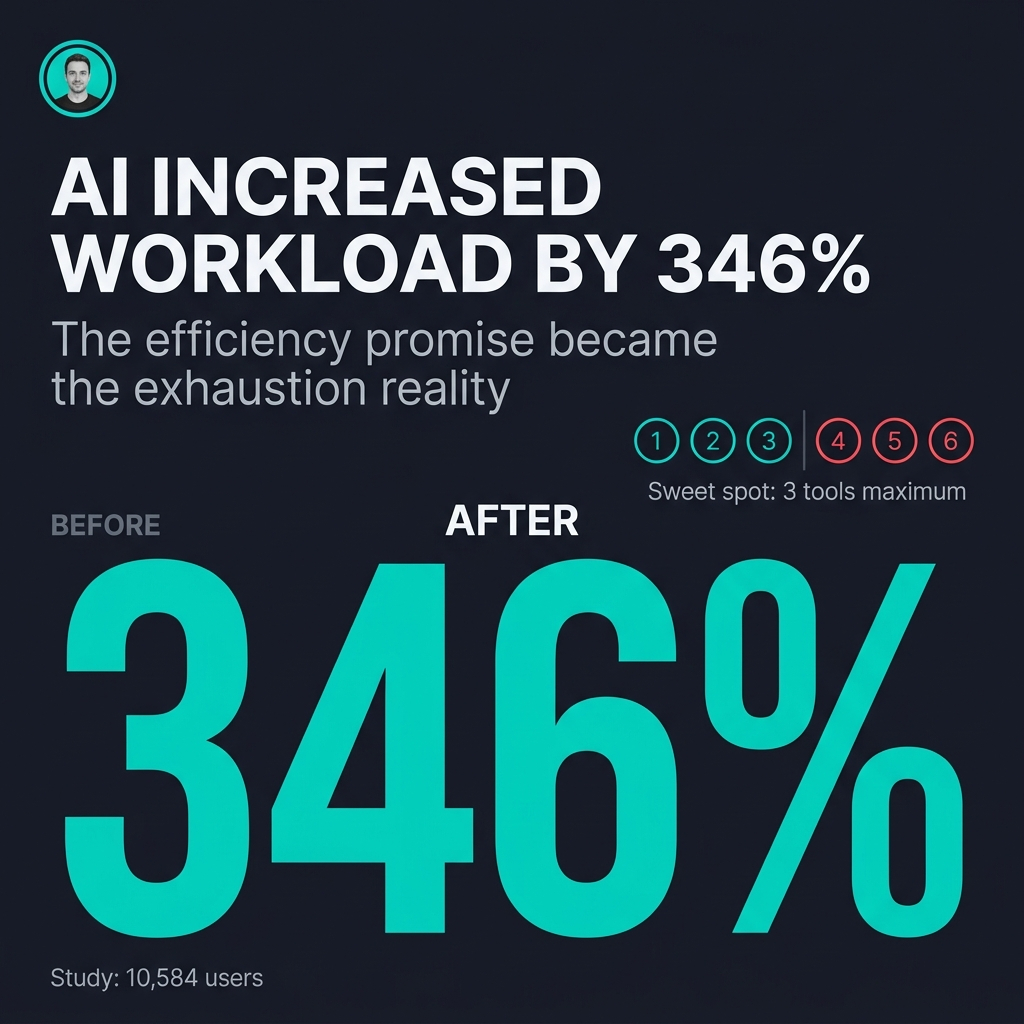
The data shows employees who used three or fewer AI tools reported improved efficiency. Efficiency plummeted for those using four or more tools.
This aligns with everything I've learnt about the 80/20 principle in business. 80% of your results come from 20% of your actions. The same applies to AI tools.
You don't need more tools. You need the right tools, used well.
I've seen this play out with marketing automation. Businesses come to me with five different systems that don't talk to each other. Their data is scattered. Their team is confused. Their marketing isn't working.
The solution isn't adding another tool. It's simplifying what they already have.
Bottom line: Three tools or fewer delivers results. Four or more creates overwhelm.
Why Isn't AI Reducing Workload?
An ActivTrak report analysed 10,584 users 180 days before and after AI adoption. Time spent across every job responsibility shot up anywhere from 27% to 346%.
Read that again. AI increased time spent on tasks by 346%.
The tools add more time to menial tasks and take away from deep-focus work. This is the opposite of what we were promised.
I've implemented technology systems for companies at a fundamental level. I know what's involved in scoping tech projects. I also know the wastage that often goes into these projects.
The problem isn't the technology. It's how we're implementing it.
Bottom line: Poor implementation turns productivity tools into time drains.
What Causes Most AI Projects to Fail?
54% of AI project failures cite adoption challenges. User adoption is the primary reason AI projects fail, not technical failures.
Here's the typical scenario:
• AI deployed with fanfare
• Usage drops to 40% by month 2
• Power users bypass it by month 3
• The system becomes shelfware by month 6
A 2024 study by Boston Consulting Group revealed 70% of AI implementation challenges are related to people and processes, not technical glitches. Employee scepticism, lack of skills, process inertia, and cultural pushback hinder AI projects far more than an algorithm not working.
By contrast, technical issues accounted for 10% of implementation challenges.
This matches what I've learnt from years of coaching small business owners. The technology is rarely the problem. The problem is understanding what you're trying to achieve and getting your team on board.
Bottom line: 70% people problems, 10% technical problems. Focus your effort accordingly.
How Does Fear Impact AI Adoption?
75% of employees worry AI could eliminate jobs. 65% fear for their own roles, according to a 2024 EY survey.
45% of CEOs say their employees are reluctant or openly hostile towards AI. 22% of employees are frustrated enough by workplace AI use to consider quitting.
You can't force adoption when people are scared.
I've worked in the counselling field. I understand human psychology and emotions. I know how this impacts people's performance in teams.
When you implement new systems without addressing the human side, you're setting yourself up for failure. People need to understand why the change matters and how it helps them do their job better.
Bottom line: Address fear before rolling out tools. People need clarity on how AI helps them, not threatens them.
Why Is Training Critical for Small Businesses?
More than 75% of small business owners say they're using AI. But only 14% are fully integrating AI into their core operations.
The gap? Training.
More than 70% of small business owners say their organisation would benefit from access to training to implement AI.
This doesn't surprise me. I've seen small businesses struggle with marketing automation because nobody showed them how to use it well.
Here's the good news: businesses that provide AI training for their workforce are seeing productivity gains upwards of 20%. Six out of ten businesses that provide AI training have boosted productivity by more than 20%, compared to three in ten businesses without training.
Training works. But it needs to be the right kind of training.
Bottom line: Businesses with AI training see 20%+ productivity gains. Those without training leave massive value on the table.
What Works: Five Steps to AI Implementation
I've spent years helping small businesses implement marketing systems that get used. Here's what I've learnt:
1. Start with strategy, not tools
Get clear on what you're trying to achieve first. Most people start the wrong way round. They get a website, start email marketing, but don't know why they're doing it.
I believe in getting a strategy in place first. Understanding who you're trying to target and how you want to reach them before you put your marketing tech in place.
The same applies to AI. What problem are you solving? How will this tool help your team do their job better? If you can't answer these questions clearly, you're not ready to implement.
2. Focus on the 20% that delivers 80% of results
You don't need every AI tool on the market. You need the few that solve your specific problems.
I help companies focus on that 20%, build up expertise in that area to give them the biggest return on their investment. Large corporate marketing tech companies keep rolling out feature after feature and create complexity for smaller service businesses.
Pick your top two or three AI tools. Master them. Then consider adding more.
3. Provide proper training and support
I don't sell people a set of tools and let them get on with it. I provide thorough support and coaching to help them maximise their effort and set them up for success.
Your team needs to understand why they're using the tools and how it makes their work better, not simply how to use them.
4. Get manager support
Employees who agree their manager supports AI use are nine times as likely to agree it helps them do what they do best every day.
Manager encouragement generates higher AI adoption and helps teams identify applications that fit workflows and solve real problems.
This isn't about forcing adoption. It's about creating an environment where people feel supported to try new things.
5. Simplify before you add
Before you add another AI tool, look at what you already have. Can you consolidate? Can you remove tools that aren't working?
Complexity breeds chaos and inefficiency. You need to simplify things to make them grow better.
I've seen businesses transform by removing tools, not adding them. They get all their marketing in one place so it's simple and easy to operate.
Bottom line: Strategy, focus, training, support, and simplification beat feature overload every time.
What Results Are Businesses Seeing?
Small businesses using AI the right way are seeing real gains.
AI use by small businesses increased by 18% compared to 2024 and has more than doubled since 2023. SMB employees save 5.6 hours per week using AI tools on average.
Four in five small businesses report productivity gains of 20% or more when implementing AI. Over 40% have seen revenues jump by at least 20%.
But these results come from doing it right. Strategy first. Focused implementation. Proper training. Manager support. Simplification over complexity.
AI fatigue isn't inevitable. It's a symptom of poor implementation.
Bottom line: Done right, AI delivers 20%+ productivity gains and revenue growth. Done wrong, it creates fatigue and resistance.
Your Next Steps
If your team is experiencing AI fatigue, you're not alone. But you don't have to accept it as the cost of innovation.
Take a step back. Look at your strategy. Count your tools. Talk to your team about what's helping them and what's adding noise.
You'll find the solution isn't adding more AI. It's using less of it, better.
I've built my business on helping small service businesses pull all their marketing together in one place so they use the latest strategies and tools to reach their ideal customers without the complexity.
The same principle applies to AI adoption. Less complexity. More focus. Better results.
Your team doesn't need to be exhausted by AI. They need clarity on what to use, why to use it, and how it makes their work better.
That's not a technology problem. That's a leadership problem. And it's one you solve.
Frequently Asked Questions
How many AI tools should my team use?
Three or fewer AI tools deliver the best results. Employees using four or more tools experience productivity drops and mental fatigue. Focus on mastering 2-3 applications that solve your specific problems before adding more.
What's the main reason AI projects fail?
54% of AI failures stem from adoption challenges, not technical issues. 70% of implementation problems relate to people and processes: lack of training, cultural resistance, unclear objectives, and poor change management.
How does AI training impact productivity?
Businesses providing AI training see productivity gains of 20% or more. Six out of ten businesses with training programmes report these gains, compared to only three in ten without training.
Why are employees resistant to AI?
75% of employees worry AI could eliminate jobs, and 65% fear for their own roles. When you add tools without addressing these fears or explaining how AI helps people do better work, resistance is natural.
How long does it take for AI implementation to fail?
The typical failure pattern shows usage dropping to 40% by month 2, power users bypassing the system by month 3, and the tool becoming unused by month 6. This happens when adoption and training are neglected.
What's AI fatigue costing businesses?
AI fatigue leads to increased errors, decision fatigue, higher turnover risk (22% of frustrated employees consider quitting), and time increases of 27% to 346% on tasks. Poor implementation turns productivity tools into drains.
How do I know if my business is ready for AI?
Ask yourself: What specific problem am I solving? How will this tool help my team do their job better? If you can't answer these clearly, you're not ready. Strategy comes before tools.
What role do managers play in AI adoption?
Employees who feel their manager supports AI use are nine times more likely to find it helpful. Manager encouragement drives adoption and helps teams identify applications that fit workflows and solve real problems.
Key Takeaways
• AI fatigue is a symptom of poor implementation, not an inevitable cost of innovation
• Keep it focused: three or fewer AI tools deliver results; four or more create overwhelm
• 70% of AI failures are people problems (training, culture, adoption), only 10% are technical
• Businesses providing AI training see 20%+ productivity gains and revenue growth
• Strategy before tools: understand your objectives and target audience before implementing
• Address fear and resistance upfront: people need to see how AI helps them, not threatens them
• Manager support multiplies adoption: employees with supportive managers are 9x more likely to benefit from AI