 NexiAI
 CleoAI
 VoxAI
VoxAI OttoAI
 RingoAI
 CallumAI
 WinnieAI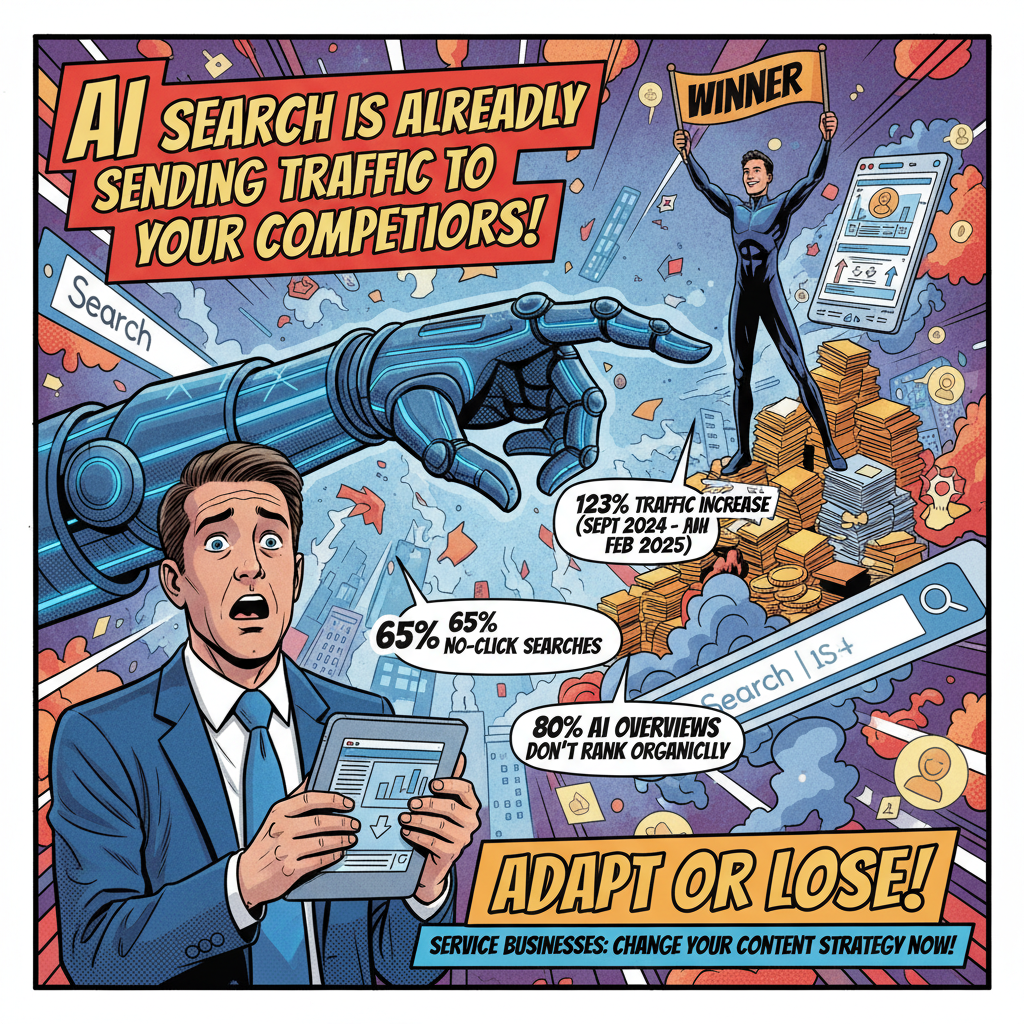
AI Search: Adapt Your Content Strategy with NEXUSPRO in 2026
TL;DR: AI-driven search traffic increased 123% between September 2024 and February 2025. More than 65% of Google searches now end without a click. 80% of sources featured in AI Overviews don't rank organically for the query. Service businesses need to adapt their content strategy now or watch competitors win the clients they should have won.
Core answer:
AI search engines (ChatGPT, Google AI Overviews) changed how people find service providers
Traditional SEO rankings don't guarantee visibility in AI-generated answers
AI systems prioritise authority signals: specific statistics, real client outcomes, comprehensive answers
Service businesses must restructure content to demonstrate expertise, not optimise for keywords
Businesses that act now gain advantage whilst larger enterprises move slowly
I've been tracking something most service business owners haven't noticed yet.
Between September 2024 and February 2025, traffic from AI-driven search engines increased by 123%. ChatGPT alone became the largest AI referrer to small business websites.
Your potential clients already use AI to find service providers. The question is whether they're finding you.
What's Changing in Search Behaviour Right Now
More than 65% of Google searches now end without anyone clicking a traditional result link. The answer appears directly on the page.
This is happening to your business right now.
Google's AI Overviews appeared in 13.14% of all searches in March, up from 6.49% in January. That's a 102% surge in two months.
Your ideal clients (business owners aged 25 to 50) already use these tools. Over 60% of Millennials and Gen Zers use AI engines in their search routines.
Traditional SEO still matters. But on its own, it's no longer enough.
Bottom line: Search behaviour shifted. AI answers replaced clicks. Your visibility strategy needs to shift too.
Why Traditional SEO Rankings Don't Protect You Anymore
I've implemented marketing systems for service businesses for years. I keep seeing the same pattern.
Business owners invest in SEO. They rank well. Their traffic looks healthy in Google Analytics.
But they're missing a massive chunk of their potential market.
Here's the problem: 80% of sources featured in AI Overviews don't rank organically for the query. Even if you hold the number one spot in traditional search results, you only have an 8% chance of being cited in an AI-generated answer.
The rules changed whilst everyone focused on the old game.
When someone asks ChatGPT or Google's AI about finding a service provider, those conversations happen in what researchers call the "AI Dark Funnel." Your web analytics don't track these interactions. You don't see the research phase. You don't see the comparison phase. You only see the end result when someone finally visits your website, or doesn't.
The reality: Traditional rankings are no longer a reliable indicator of visibility. AI systems use different criteria to choose which sources to cite.
How the 80/20 Principle Applies to AI Search
I apply the 80/20 principle to everything in business. This space is no exception.
Most businesses waste effort trying to rank for hundreds of keywords. They create content without understanding what AI systems value.
Research from Princeton University found that Statistics Addition and Quotation Addition consistently outperformed traditional SEO tactics like keyword stuffing. These approaches showed up to 41% improvement in visibility-related metrics.
What does this mean for your business?
AI systems prioritise content that demonstrates authority. They look for specific data points. They value direct quotes from credible sources. They reward comprehensive answers.
You don't need to create more content. You need to create the right content in the right format.
One of my clients in the professional services sector restructured their content strategy around this principle. They focused on their five most important service areas. They added specific statistics and case study data to each piece.
Within three months, their visibility in AI-generated responses increased measurably. More importantly, the quality of their enquiries improved.
The takeaway: Focus beats volume. AI systems reward depth and authority in core areas over broad keyword coverage.
What Service Businesses Must Do Differently
I've worked with small businesses long enough to know that complexity kills execution. You're already stretched thin. You spend less than five hours a week on marketing.
You don't need another complicated system. You need clarity on what works.
Here's what matters:
1. Build authority systematically
AI systems don't look at keywords alone. They evaluate whether your content demonstrates genuine expertise. Include specific data. Reference real client outcomes. Show your working.
2. Optimise for informational queries
AI Overviews appear disproportionately for informational searches. These are your top-of-funnel opportunities. When someone asks "how to choose a [your service]" or "what to look for in a [your industry]," you want to be the source AI systems cite.
3. Simplify your content structure
AI systems parse content differently than humans do. Clear headings matter. Concise answers matter. Structured data helps AI understand what you're saying.
4. Focus on your core expertise areas
You don't get to be everything to everyone. Pick the three service areas where you genuinely excel. Create comprehensive, authoritative content for those areas. Ignore the rest.
What this means: AI visibility comes from demonstrating expertise in focused areas, not trying to rank for everything.
Why Service Businesses Have an Advantage Right Now
Research from Semrush predicts that LLM traffic will overtake traditional Google search by the end of 2027. Some companies already see an 800% year-over-year increase in referrals from AI systems.
This creates an advantage for businesses that act now.
Large enterprises move slowly. They have layers of approval. They're still figuring out their AI strategy whilst dealing with legacy systems and departmental politics.
Service businesses with revenues between £1M and £10M move faster. You adapt your content strategy this month. You restructure your website this quarter.
The businesses that establish their presence in AI search results now will have a significant head start.
I've seen this pattern before. When Google changed its algorithm dramatically, the businesses that adapted quickly gained market share. The ones that waited lost ground they never recovered.
The opportunity: Smaller service businesses win because they adapt faster than enterprise competitors.
How This Fits Into Your Marketing System
Here's where most service businesses get stuck.
They understand the opportunity. They recognise the shift. But they're already managing disjointed marketing tools. Their data lives in multiple systems. They don't have time to research the latest strategies.
This is exactly why I set up NEXUSPRO the way I did.
You need your marketing in one place. You need systems that handle the complexity behind the scenes whilst staying simple to operate. You need to implement current strategies without spending weeks researching them.
91% of small and medium businesses using AI say their revenue grows because of the implementation. But only if it's implemented properly. Only if someone ensures it works for your specific situation.
The businesses growing fastest right now aren't using more tools. They're using the right tools in the right way.
The truth: AI search visibility requires integrated systems, not more disconnected tools.
Your Next Steps
You don't need to overhaul everything immediately.
Start with your three most important service pages. Add specific statistics. Include real client outcomes. Structure the content so AI systems parse it easily.
Review your content through this lens: Does this demonstrate genuine expertise? Does this answer questions comprehensively? Would an AI system cite this as a credible source?
Track where your traffic comes from. Watch for referrals from ChatGPT and other AI platforms. AI referral traffic as a percentage of organic traffic jumped from 0.54% to 1.24% in six months for businesses paying attention.
Here's what you need to understand: This isn't a temporary trend. This is how people find service providers now.
The businesses that adapt their marketing systems to this reality will grow. The ones that ignore this shift will wonder why their competitors keep winning the clients they should have won.
I've spent years helping service businesses cut through marketing complexity. This shift to AI-driven search is significant. But manageable if you focus on what works.
Simplify your approach. Focus on authority. Build systems that work whilst you're running your business.
Your potential clients already use AI to find solutions. Make sure they find you.
Common Questions About AI Search Optimisation
Do I need to abandon traditional SEO for AI search?
No. Traditional SEO still matters. But you need to layer in AI optimisation. Focus on authority signals (specific data, real outcomes, comprehensive answers) alongside keyword optimisation. The businesses winning do both.
How long does optimising for AI search take?
Start seeing results in 3-6 months if you focus on your core service areas. One of my clients restructured their top five pages with statistics and case data. Within three months, their AI visibility increased and enquiry quality improved.
What's the single most important change to make?
Add specific statistics and real client outcomes to your core service pages. AI systems prioritise content that demonstrates expertise through data. This single change has more impact than any other optimisation.
How do I track AI search traffic?
Check your referral sources in Google Analytics. Look for traffic from chatgpt.com, perplexity.ai, and other AI platforms. AI referral traffic jumped from 0.54% to 1.24% in six months for businesses tracking this metric.
Do small businesses stand a chance against larger competitors?
Yes. In AI search, you have an advantage. Large enterprises move slowly with layers of approval. You adapt your content strategy this month. Speed matters more than size in this shift.
What if I only spend 5 hours a week on marketing?
Focus on your three most important service pages. Add statistics, outcomes, and clear structure. You don't need to optimise everything. The 80/20 principle applies: 80% of your results will come from 20% of your content.
Will AI search replace Google completely?
Research from Semrush predicts LLM traffic will overtake traditional Google search by the end of 2027. Some companies already see an 800% year-over-year increase in AI referrals. This isn't replacing Google overnight, but the trend is clear.
What happens if I ignore this shift?
Your competitors gain visibility whilst you become invisible. 65% of Google searches now end without a click. If your content isn't optimised for AI systems, potential clients won't find you during their research phase. You'll lose opportunities to competitors who adapted.
Key Takeaways
AI-driven search traffic increased 123% between September 2024 and February 2025, with ChatGPT becoming the largest AI referrer to small business websites
80% of sources featured in AI Overviews don't rank organically for the query, meaning traditional SEO success doesn't guarantee AI visibility
AI systems prioritise authority signals over keywords: specific statistics, real client outcomes, and comprehensive answers outperform traditional optimisation
Service businesses with revenues between $1M and $10M have a speed advantage over slower-moving enterprises
Focus on your three core service areas with data-rich, authoritative content rather than trying to optimise everything
Track AI referral traffic from ChatGPT, Perplexity, and other AI platforms to measure your visibility in this new channel
The businesses that adapt their content strategy now will establish presence whilst competitors figure out their approach

