

Before You Touch the Campaign, Diagnose the Follow-Up
TL;DR: Service business owners routinely cut ad budgets when leads stop converting. In most cases, the campaign is fine. The follow-up is where the deal dies. Diagnose your follow-up process before you spend another penny on acquisition.
Over 63% of businesses fail to respond to new leads at all.
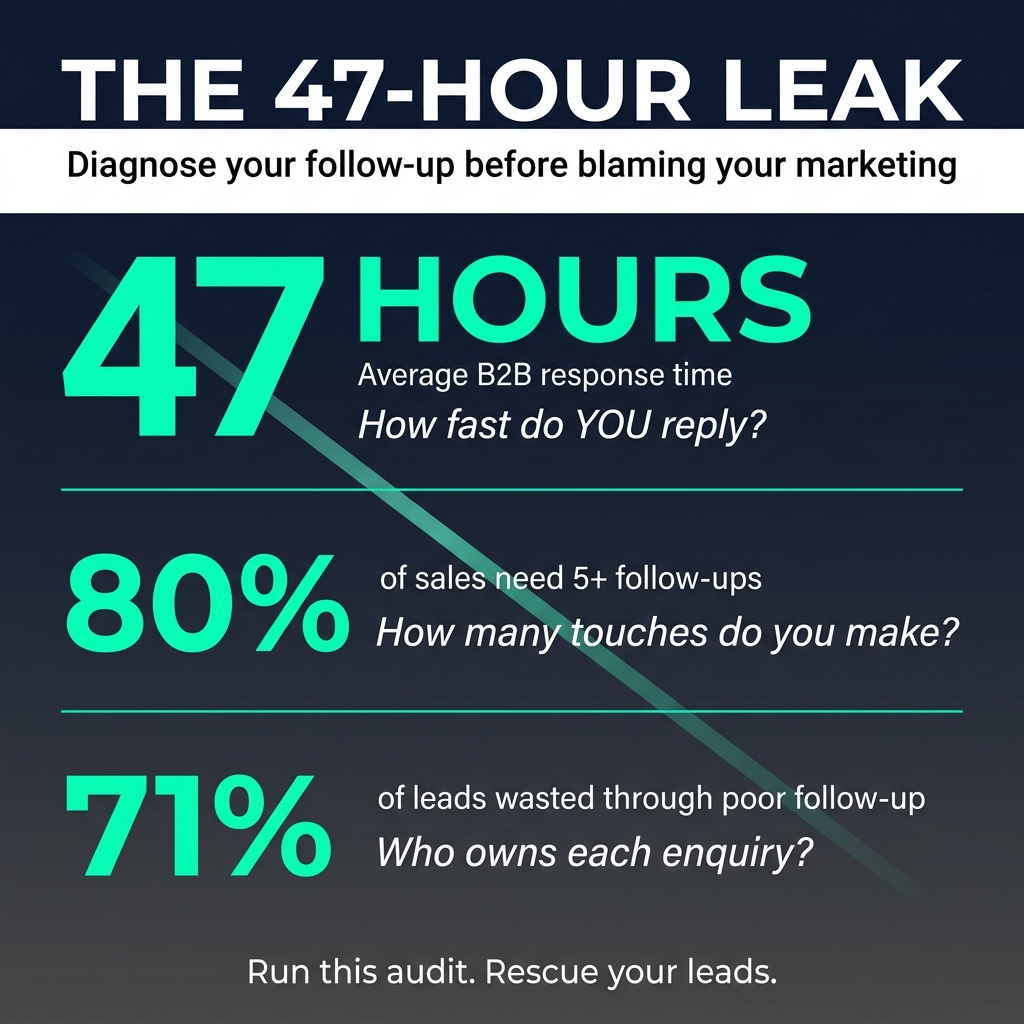
The average B2B response time is 47 hours. Your competitor often replies in minutes.
35 to 50% of sales go to the first vendor who responds.
80% of sales require five or more follow-up touches. 44% of sellers quit after one.
Speed, consistency and named ownership are the three levers. Fix all three and you have a system that compounds every campaign you run.
What Is Really Happening After the Lead Comes In?
Sit down with a service business owner whose leads aren't converting and the conversation goes roughly the same way every time. The campaign gets blamed. The channel gets killed. The budget gets cut.
Then you look at what actually happened after the lead came in.
Business owners believe their follow-up is fine. They sent a quote. They sent a text. Job done, in their mind. That belief is one of the most expensive blind spots in running a service business, and it sticks around precisely because admitting a process problem feels harder than blaming an advert.
Bottom Line
The campaign rarely fails first. The follow-up does.
What Do the Numbers Actually Show?
Over 63% of businesses fail to respond to leads at all, and the average B2B response time sits at 47 hours.
Forty-seven hours. Your prospect filled in a form on Tuesday morning and heard nothing until Thursday. By then their attention has moved. A competitor has already spoken to them, because 35 to 50% of sales go to the vendor that responds first.
Speed is not a nice-to-have. For service businesses operating in competitive local markets, it is the primary conversion lever. And it is one that does not require a bigger ad budget.
Bottom Line
A 47-hour response time is not a campaign problem. It is a process problem, and it is costing you deals you already paid to generate.
Why Does Persistence Matter So Much?
Speed alone will not close it. The follow-up has to continue after the first touch.
Around 80% of sales require five or more follow-ups, yet 44% of sellers give up after a single attempt. One quote, one text, then nothing.
The owner remembers the effort. The lead remembers nothing, because nothing memorable happened after that first message.
To be direct about this: the follow-up failure is a systems issue. Treating it as a willpower or discipline issue misses the point entirely. High-growth service businesses build systems that make follow-up happen automatically, every time, without relying on someone remembering to do it.
Bottom Line
44% of sellers stop after one follow-up. 80% of buyers need five. That arithmetic explains a lot of lost revenue.
Why Do Owners Miss It?
Follow-up failure is invisible. That is the core reason it persists.
A failed campaign shows up in a dashboard. A lead that went cold in a forgotten spreadsheet shows up nowhere. Nobody logs the deal that died because the reply came 47 hours late. The loss leaves no trace, so the owner concludes the marketing failed and cuts the budget.
Businesses spend thousands on new campaigns while 71% of internet leads are wasted through poor follow-up. That is the equivalent of filling a leaking bucket and blaming the tap.
This is where the 80/20 principle applies directly. In most service businesses, the follow-up process sits firmly in the 20% of activity that drives 80% of results. Fixing it costs a fraction of what a new campaign costs, and it improves the return on every campaign already running.
Bottom Line
Invisible losses do not trigger audits. That is exactly why follow-up failure compounds quietly over months before anyone investigates it.
How Do You Diagnose Your Follow-Up?
Before touching another campaign, run this audit on your own business.
Speed: Time how long a new enquiry waits before someone responds. Measure in hours, not assumptions.
Consistency: Count your follow-up touches per lead. If the answer is one or two, you are stopping before the majority of sales happen.
Ownership: Name the person who owns each lead between form submission and first human contact. If no name comes to mind, that is your leak.
Address one of those three and you have a partial fix. Address all three and you have a functioning system.
This diagnosis takes an afternoon. You need your inbox, your CRM if you have one, and a willingness to look at what the numbers actually say.
Bottom Line
Speed, consistency and ownership. Three specific things to audit. The ones with no clear answer are where revenue is being lost right now.
What Is the Competitive Reality for Service Businesses?
Prospects contact several providers at once. That is the market service businesses operate in today.
The business that responds in minutes, follows up consistently and assigns clear ownership wins a disproportionate share of that enquiry volume. Service quality matters enormously once you win the client. Getting to that point depends on what happens in the hours after the enquiry lands, not months later in a campaign review.
I built NEXUSPRO around this conviction. I kept working with capable, hardworking business owners who were losing winnable work to competitors who simply answered faster and stayed in touch longer. Better tools and a clear strategy fix that.
Diagnose your follow-up before spending another pound on campaigns. Simplify the process, automate the response, and give every lead a named owner. The leads already in your pipeline are worth more attention than the next campaign brief.
Bottom Line
Faster response and consistent follow-up are operational choices, not budget decisions. Service businesses that make those choices win work that better-resourced competitors miss.
Frequently Asked Questions
How quickly should a service business respond to a new lead?
Within five to fifteen minutes of the enquiry landing, if possible. Studies show conversion rates can increase by 30 to 70% when a lead is contacted within that window. An automated SMS or email sent immediately holds the lead's attention until a human can follow up properly.
What counts as a follow-up sequence for a service business?
A basic sequence touches the lead on day one, day three and day five at minimum. Each touch adds context or value rather than repeating the same message. As the sequence matures, businesses can automate the first two or three touches and assign the later ones to a person.
Do I need a CRM to fix my follow-up process?
A CRM helps, but it is not the starting point. The starting point is naming who owns the lead and defining how quickly they respond. A spreadsheet with clear ownership and a manual reminder is better than an unused CRM. Technology works best once the process is defined, not as a substitute for one.
Why do business owners keep blaming campaigns when follow-up is the real issue?
Because campaign failure shows up in data and follow-up failure does not. A dashboard shows cost per click and conversion rate. It does not show the lead that went cold because nobody replied for two days. Invisible failures do not get investigated, so the visible metric, the campaign, takes the blame.
What is the minimum viable follow-up system for a small service business?
An automated first response within minutes of the enquiry landing, followed by a day one, day three, day five sequence via SMS or email, and a named person who picks up any lead that reaches day five without converting. That structure covers the basics without requiring a large team or expensive software.
How does lead qualification change the follow-up process?
Qualifying the lead at the point of capture, through form questions about budget, urgency or goals, allows the follow-up to be specific rather than generic. A lead with a stated budget and a clear deadline gets a different response to one that has provided only a name and phone number. Qualification does not slow the process down; it makes the follow-up more relevant and therefore more likely to convert.
Does faster follow-up actually improve close rates?
The data is consistent across multiple studies. Responding within five minutes versus thirty minutes increases the likelihood of qualifying the lead by up to 21 times. The underlying reason is simple: the prospect is in the moment when they submit the form. That context shifts quickly once they move on with their day.
Should I fix my follow-up before running more ads?
In most cases, yes. Running more acquisition spend into a broken follow-up process increases the volume of leads being wasted, not the number converting. Diagnose the follow-up first, fix the three levers of speed, consistency and ownership, then scale the campaign.
Key Takeaways
Over 63% of businesses do not respond to leads at all. Average response time is 47 hours. Both figures represent winnable improvements, not campaign problems.
35 to 50% of sales go to the first vendor who responds. Speed to lead is a direct revenue lever for service businesses.
80% of sales need five or more follow-up touches. Stopping at one or two is where the majority of deals are lost.
Follow-up failure is invisible in standard dashboards. That invisibility is why it persists and why campaigns get blamed instead.
The 80/20 principle applies clearly here. Fixing follow-up sits in the 20% of activity that drives 80% of results, at a fraction of the cost of a new campaign.
Audit three things: speed of first response, number of follow-up touches and named ownership of each lead. Any gap in those three is where revenue is leaking.
Qualifying the lead at capture makes every subsequent follow-up more targeted and more effective. Start the sales conversation before a human picks up the phone.