 NexiAI
 CleoAI
 VoxAI
VoxAI OttoAI
 RingoAI
 CallumAI
 WinnieAI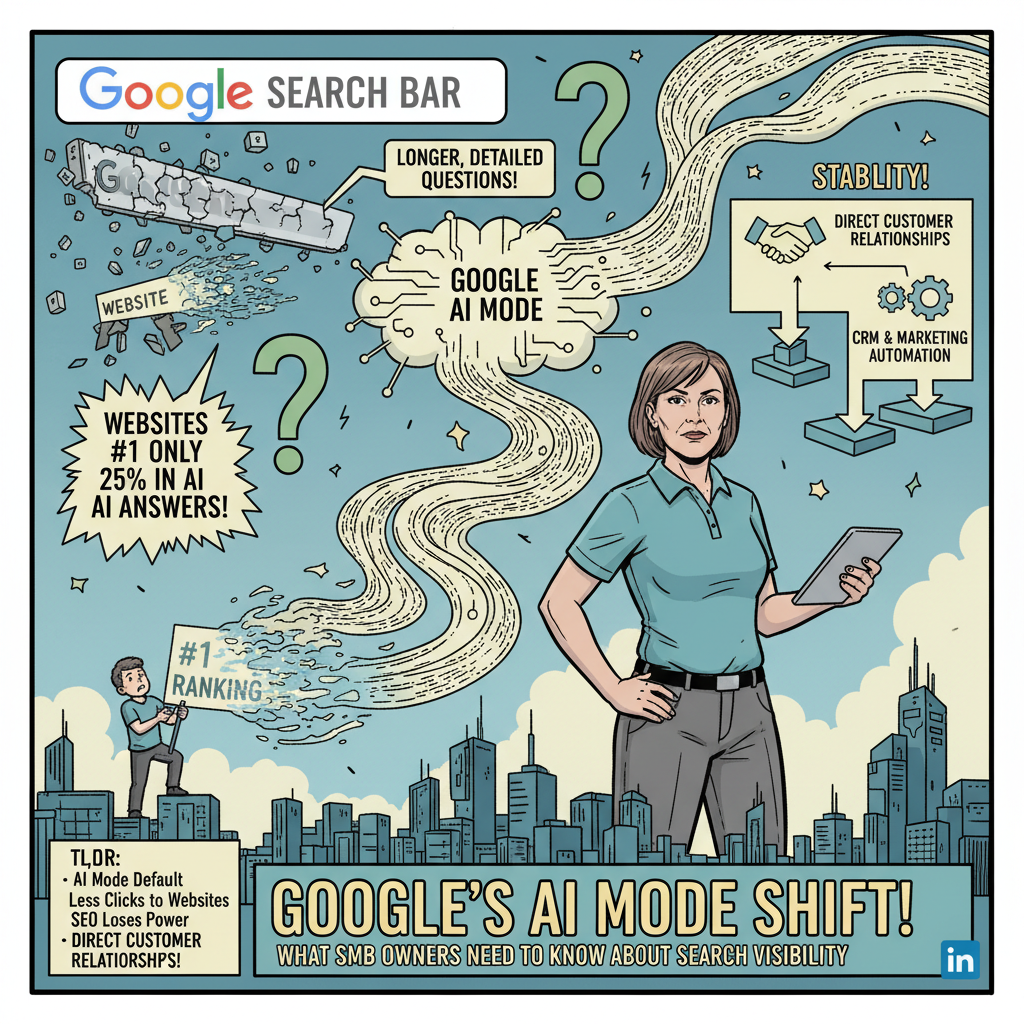
Google AI & SMBs: Improve Search Visibility in 2026
TL;DR: Google is testing AI Mode as the default search experience. Answers appear directly in search results, fewer people click through to websites, and traditional SEO loses effectiveness. Your business needs direct customer relationships and integrated marketing systems to maintain visibility.
Google AI Mode delivers these changes to your search visibility:
Websites ranked #1 appear in AI answers only 25% of the time
Users ask longer, more detailed questions (2-3x longer than traditional searches)
Direct customer relationships become more valuable than keyword rankings
Marketing automation and CRM systems provide stability when search algorithms shift
What Is Google AI Mode?
Google is moving to make AI Mode the default search experience. Logan Kilpatrick, Google's lead product manager for AI products, confirmed the company is testing this change.
The shift has started.
AI Mode crossed 100 million monthly active users in the US and India alone, according to Google CEO Sundar Pichai during the Q2 2025 earnings call.
For SMB owners and marketing professionals, this transforms how customers find your business.
Bottom line: AI Mode answers questions directly in search results, reducing clicks to websites.
How Does AI Mode Work Differently?
AI Mode operates differently from traditional search. Users type queries two to three times longer than standard searches, according to Liz Reid, Google's head of Search. These detailed queries give Google more context to deliver targeted answers.
The system answers questions directly within the search interface. Users get what they need without clicking through to websites. This changes the path customers take to reach your business.
Google made $264.59 billion from advertising in 2024, representing 78% of its total revenue. The company is integrating monetisation into AI Mode whilst protecting this business model. This opens opportunities for paid visibility as organic traffic diminishes.
What this means: Search behaviour is changing because users get direct answers, and paid visibility will matter more as organic reach declines.
What Does This Mean for Your Visibility Strategy?
Traditional SEO tactics are losing effectiveness. Research analysing 25,000 user searches found websites ranked number one on Google appear in AI search answers only 25% of the time.
The fundamentals have shifted from creating the best pages to providing the best answers. AI search engines prioritise expertise, experience, authoritativeness and trustworthiness over traditional SEO metrics.
Industry experts describe a traffic decline for businesses relying solely on organic search. The Columbia Journalism Review uses the term "traffic apocalypse" to describe what happens when AI answers questions directly.
Your visibility now depends on brand authority instead of keyword rankings.
Here's what's changed: Brand expertise and direct customer access matter more than your position in search results.
Why Customer Relationships Matter More Now
This shift makes owned customer relationships more valuable than search rankings. Businesses with strong CRM systems and direct customer communications have advantages over those relying on organic discovery alone.
The 80/20 principle applies here. Your top 20% of customers generate the majority of your revenue. These relationships become your most valuable asset when search visibility becomes unpredictable.
Multi-channel engagement becomes critical. Email, SMS, direct messaging and phone communications give you direct access to customers without depending on search algorithms. You own these relationships. Platforms change their rules, but your customer database stays yours.
Marketing automation delivers measurable ROI in this environment. Businesses using automation see ROI increases of 25% according to industry data. The technology executes your strategy consistently whilst you focus on high-value customer interactions.
Key insight: Direct customer communications provide stability because you control the channel, unlike search algorithms.
What Should SMB Owners Do Right Now?
Step 1: Audit Your Visibility Sources
Audit your current visibility sources. How much traffic comes from organic search? What percentage comes from direct customer relationships? This reveals your vulnerability to search algorithm changes.
Step 2: Build Your Customer Database
Build your customer database systematically. Every interaction should capture contact information. Every transaction should strengthen the relationship. Marketing systems integrating CRM, communications and automation make this manageable for small teams.
Step 3: Focus on What Works
Focus on the vital few instead of the trivial many. Two out of ten marketing strategies generate 80% of your results. Identify which channels deliver customers and double down on those.
Step 4: Make Marketing Core Operations
Treat marketing as core operations instead of an optional activity. High visibility and low response times maintain customer relationships through simple daily plans. Automation handles routine tasks whilst your team focuses on meaningful human connections.
Action summary: Audit your traffic sources, build your database, focus on high-performing channels, and automate routine marketing tasks.
What Do the Numbers Tell Us?
82% of users find AI-powered search more helpful than traditional search, according to industry surveys. Yet only 22% of marketers have set up monitoring for AI search visibility. This gap opens both a challenge and an opportunity.
Early signals from Microsoft's Copilot show when systems deliver fewer but more relevant advertisements, engagement and conversions rise. Advertising at the moment of relevance stays critical, but the mechanism shifts from keywords to context.
Prompts become the new starting point instead of keywords. Your content strategy needs to answer the detailed questions customers ask, providing expertise instead of optimising for search terms.
The data shows: Users prefer AI search, but most businesses haven't adapted their monitoring or strategy yet.
What Happens in the Next 12 Months?
Google's AI Overviews are driving over 10% more queries in major markets like the US and India. People come to Google to ask more questions, including more complex, longer and multimodal questions. The volume of commercial queries increases as well.
This opens opportunities for businesses adapting quickly. Brand discovery happens differently when AI curates answers. Your expertise, your customer relationships and your ability to provide genuine value matter more than your ability to game search algorithms.
Small businesses face a choice between building owned customer relationships or staying dependent on platform algorithms. Businesses owning their customer data and communications channels will weather this transition. Those relying solely on organic search face challenges.
Looking ahead: Query volume increases, complexity rises, and businesses with owned customer channels gain stability.
How to Build Your Foundation
You need to address this shift. The transition from traditional search to AI Mode represents a fundamental change in how customers discover businesses.
Start small. Pick one area this month to strengthen your customer relationships. Implement automation in one routine process. Build your database systematically. Focus on the 20% of activities generating 80% of your results.
Marketing systems make expertise accessible to customers. Automation executes strategy consistently. Customer relationships provide stability when algorithms change. These three elements form a foundation for surviving platform shifts.
Businesses thriving in this environment will build direct relationships with customers, provide genuine expertise and use technology to scale personal service. Start building your foundation today.
Your action plan: Choose one relationship-building focus, automate one process, and concentrate on your highest-return activities.
Frequently Asked Questions
Will traditional SEO become completely useless?
Traditional SEO isn't disappearing, but its effectiveness is declining. Websites ranked #1 appear in AI answers only 25% of the time. Focus shifts from keyword rankings to brand authority and providing expert answers to detailed questions.
How long do I have to prepare for this change?
Google is testing AI Mode as the default now. With 100 million monthly active users already, the transition is happening. Start building direct customer relationships and integrated marketing systems immediately.
What's the most important thing to do first?
Audit your traffic sources. Understand how much you rely on organic search versus direct customer relationships. This shows your vulnerability and helps you prioritise where to invest effort.
Do I need to spend more on paid advertising?
Paid advertising becomes more important as organic reach declines. Google is integrating monetisation into AI Mode. Budget for paid visibility, but balance this with owned customer channels like email and SMS.
What marketing automation tools should small businesses use?
Look for integrated platforms combining CRM, email, SMS and automation in one system. This approach follows the 80/20 principle, focusing on the 20% of tools delivering 80% of results. Integration matters more than feature count.
How do I build brand authority for AI search?
Focus on expertise, experience, authoritativeness and trustworthiness. Answer detailed questions your customers ask. Create content demonstrating genuine knowledge. Build direct relationships showing you understand their business challenges.
What if my business relies heavily on organic search traffic?
Start diversifying now. Build your customer database systematically. Implement marketing automation to maintain relationships. Develop multi-channel engagement through email, SMS and direct messaging. This reduces dependence on search algorithms you don't control.
Will small businesses be disadvantaged compared to larger companies?
Small businesses with strong customer relationships and integrated marketing systems have advantages. You're more agile and you adapt faster. Focus on direct customer access and personal service at scale through automation.
Key Takeaways
Google AI Mode answers questions directly in search results, reducing website clicks by 75% for top-ranked sites
Direct customer relationships through CRM and multi-channel communications provide more stability than search rankings
The 80/20 principle applies: focus on the 20% of marketing activities generating 80% of your results
Marketing automation increases ROI by 25% and executes strategy consistently whilst you focus on high-value interactions
Brand authority and expertise matter more than keyword rankings in AI search environments
Start now: audit your traffic sources, build your customer database, and implement automation in one routine process
Businesses owning their customer data and communications channels will weather the transition better than those relying solely on organic search

