 NexiAI
 CleoAI
 VoxAI
VoxAI OttoAI
 RingoAI
 CallumAI
 WinnieAI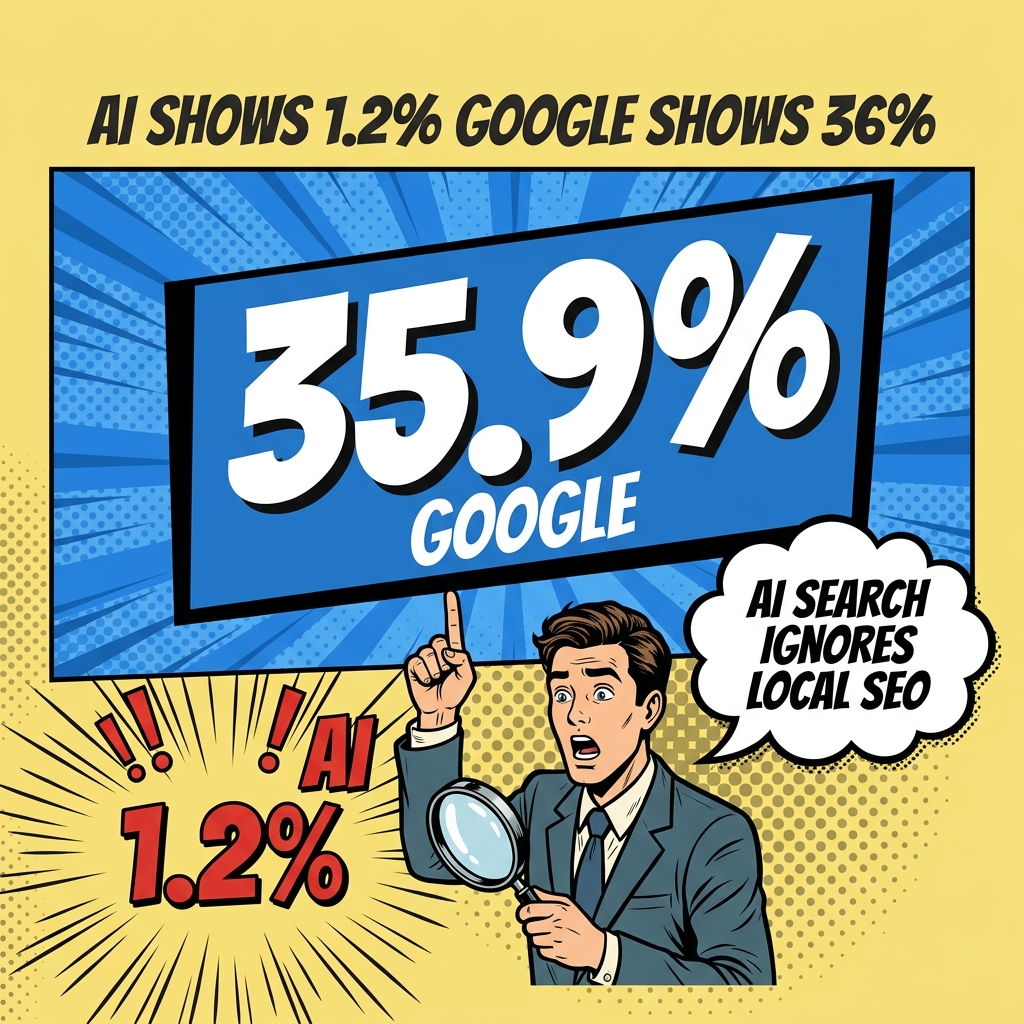
How To Build Local Pages That Win In AI-Powered Search
TL;DR: AI-powered search engines recommend only 1.2% to 11% of businesses they index, compared to 35.9% in traditional Google local results. To win AI visibility, you need complete schema markup, 50+ reviews, genuinely localised content, quarterly content updates, and question-based page structure. Generic location pages fail because AI evaluates confidence through data completeness, review quality, and local specificity.
AI search engines answer questions without sending people to your website. Google's AI Overviews appear in 40% of local business queries. ChatGPT recommends only 1.2% of locations it knows about.
AI visibility is 30 times harder than traditional local search
ChatGPT recommends 1.2% of locations, Gemini 11%, Perplexity 7.4%
Traditional local SEO success doesn't transfer to AI search
Schema markup, 50+ reviews, and local specificity drive AI recommendations
95% of AI citations come from content less than 10 months old
Traditional local SEO won't work anymore.
Here's how to build location pages AI search engines recommend to customers.
What Is the AI Visibility Problem for Local Businesses?
Look at the numbers.
ChatGPT recommends 1.2% of locations. Gemini recommends 11%. Perplexity recommends 7.4%. Google's local 3-pack shows 35.9% of businesses.
AI visibility is 30 times harder to achieve than traditional local search visibility.
The gap is wider than most businesses realise.
Strong performance in traditional local search doesn't guarantee AI visibility. In retail, only 45% of brands leading in traditional local search appeared amongst the most recommended in AI results. A 55% gap exists between brands visible on Google but invisible to AI assistants.
The rules changed. Your existing local SEO work might not transfer to this new environment.
Bottom line: AI search platforms evaluate different signals than traditional search engines, making previous visibility gains non-transferable.
Why Do Traditional Location Pages Fail in AI Search?
I see the same mistakes across businesses.
Businesses create cookie-cutter location pages. They swap out the city name. They duplicate the same content.
This approach fails.
AI systems evaluate confidence. They recommend locations when they have high confidence in the accuracy, quality, and reputation of a business. Locations with incomplete data, inconsistent listings, low ratings, or poor review engagement fail the confidence threshold.
These businesses get excluded entirely.
Traditional SEO focused on optimising everything. Strategic SEO focuses on optimising what matters. AI search demands the strategic approach.
Simplify to succeed.
Bottom line: AI systems filter out generic, duplicated content because they need high confidence in business accuracy before making recommendations.
How to Set Up Schema Markup for AI Search
Start with what AI systems check first.
Schema markup is non-negotiable. Websites without proper schema implementation miss major SEO opportunities because AI search engines rely on structured and accessible data to understand website content.
Schema markup helps AI engines read your content. Services, locations, pricing, reviews. AI search engines generate answers based on clear, structured information they crawl online.
Your location pages need this schema:
LocalBusiness schema with complete NAP (name, address, phone)
Service schema for each service you offer
Review schema to display ratings
Opening hours schema
Geographic coordinates
This is the price of entry.
Next, fix your Google Business Profile. The 50-review threshold matters. Crossing 50 reviews is the single highest-leverage local SEO milestone. GBPs with 100+ reviews in 2025 saw lead volume rise 31% year-on-year in 2026.
Reviews don't just influence humans. They train algorithms. Review content matters more than star ratings. AI tools read sentiment, patterns, and context. A review mentioning service speed, location, or specific offerings feeds hyperlocal SEO signals.
Bottom line: Complete schema markup and 50+ quality reviews form the technical foundation AI systems require before evaluating your content.
How to Demonstrate Local Understanding on Location Pages
Generic location pages fail because AI prefers specificity.
AI systems favour businesses demonstrating real understanding of communities they serve. Cookie-cutter approaches don't work.
Your location pages must show you understand the local area. Not just the postcode. The actual community.
Here's the approach:
Reference local landmarks and areas. Don't say "serving Manchester." Say "serving businesses near Spinningfields and the Northern Quarter." Be specific about the areas you cover.
Address local problems. What challenges do businesses in your specific area face? A location page for a marketing automation company in Leeds should mention different pain points than one in Brighton.
Use local language. How do people in your area describe their needs? What terms do they use? Mirror the language.
Show local proof. Case studies from your area. Testimonials from local clients. Results you've achieved for businesses in the community.
This takes more work than duplicating a template. AI systems reward genuine localisation over manufactured scale.
Bottom line: AI evaluates whether your location page demonstrates genuine community knowledge through specific landmarks, local problem-solving, and area-specific proof.
How to Structure Content for Question-Based Search
Search behaviour changed.
Fewer direct queries like "pizza" appear. More question-based queries like "what kind of pizza is near me" dominate. People use AI search programmes to ask questions instead of typing keywords.
Your location pages need to answer the questions your potential customers ask.
What does someone searching for your service in your location want to know?
What services do you offer in this area?
How quickly do you respond?
What makes you different from competitors here?
What results have you achieved for local businesses?
How much does it cost?
Structure your content around these questions. Use natural language. Write like you're having a conversation.
AI systems prefer content mirroring natural-language phrasing. Your location pages should read like answers, not sales pitches.
Bottom line: Question-based content structure aligns with how people search using AI tools, increasing your chances of being cited as the answer.
How Often Should You Update Local Pages?
AI checks how fresh your content is.
Publishing fresh content signals to AI your business is active and credible. 95% of ChatGPT citations come from content less than 10 months old.
You don't need to rewrite everything constantly. Updates work.
Add a new case study. Update service descriptions. Add recent reviews. Refresh local area information. These small updates signal activity.
Set a schedule. Review each location page quarterly. Make meaningful updates. Keep the content current.
This matters more than most businesses realise.
Bottom line: Quarterly updates to location pages keep content fresh enough for AI citation whilst remaining manageable for small businesses.
Why the 24-Hour Window Matters for Local Search
Local searches carry immediate intent.
76% of consumers searching "near me" visit a business within 24 hours. Near-me searches have extraordinarily high conversion-to-visit rates. Being invisible during this window compounds faster than most businesses model.
Your location pages need to convert quickly.
Make your contact information obvious. Show your availability. Make it easy to book or enquire. Remove friction.
88% of consumers doing a local search on their smartphone visit or call a store within a week. 18% of local mobile searches lead to a purchase within one day.
Speed matters. Clarity matters. Simplicity matters.
Bottom line: Location pages must convert fast because 76% of local searchers take action within 24 hours.
What Is GEO and How Does It Differ from Traditional SEO?
GEO (Generative Engine Optimisation) changed how SEO works in 2026.
Keyword-stuffed pages matter less now. Low-quality backlinks matter less. Duplicated location pages matter less.
Authority, clarity, and real-world relevance matter more.
This aligns with how I've approached marketing. Focus on the 20% delivering 80% of results. Strategy before tactics. Simplicity over complexity.
Traditional SEO focused on earning visibility converting to clicks. AI search optimisation focuses on supplying information so AI agents find, trust, and use it without a user visiting your site.
Success gets measured differently. You're not trying to get the click. You're trying to be the cited source.
Bottom line: GEO prioritises being cited as the authoritative source over generating click-throughs to your website.
How to Optimise Location Pages for Voice Search
76% of voice searches are "near me" or local enquiries.
Three in four voice queries have local intent. Optimising for conversational queries is required.
Your location pages need to work for voice search:
Answer questions directly
Use conversational language
Include FAQ sections
Structure content for featured snippets
Make key information easy to extract
Voice search users want quick answers. Give them what they need in the first few sentences.
Bottom line: Voice search optimisation requires conversational language and direct answers in the opening sentences of your content.
What Service Businesses Should Prioritise
I work with service businesses spending five hours weekly or less on marketing.
You don't have time to optimise everything. You need to focus on what moves the needle.
Here's your priority list:
1. Fix your technical foundation. Get schema markup right. Complete your Google Business Profile. Make sure your NAP is consistent everywhere.
2. Build genuinely localised pages. One well-crafted location page beats ten generic ones. Focus on quality over quantity.
3. Gather reviews systematically. Cross the 50-review threshold. Then aim for 100. Make review collection part of your process.
4. Update content regularly. Quarterly reviews. Small updates. Keep it fresh.
5. Answer questions clearly. Structure content around what people ask. Use natural language.
This approach works. It requires discipline.
Bottom line: Focus on five priorities (schema, localisation, reviews, updates, questions) rather than trying to optimise everything.
What Is the Confidence Signal in AI Search?
AI systems evaluate confidence above everything else.
They recommend locations when they have high confidence in accuracy, quality, and reputation of a business. Locations with incomplete data, inconsistent listings, low ratings, or poor review engagement fail the confidence threshold.
Your job is to build confidence systematically.
Complete information. Consistent data. Quality reviews. Fresh content. Local understanding. Clear answers.
Each element reinforces the others. Together, they create the confidence signal AI systems look for.
Bottom line: The confidence signal combines data completeness, consistency, review quality, content freshness, and local specificity to determine recommendation worthiness.
How to Get Started with AI-Optimised Location Pages
You don't need to rebuild everything overnight.
Start with your most important location. Get it right. Then replicate the approach.
Focus on the fundamentals:
Schema markup
Complete Google Business Profile
Genuinely localised content
Regular updates
Question-based structure
This approach works because it's based on what AI systems evaluate. Not guesswork. Not trends.
Clarity. Simplicity. Strategy.
The same principles working in marketing automation work in local SEO. Less is more. Focus on what matters. Build systems scaling without scaling time.
Bottom line: Start with one location page, perfect the fundamentals, then replicate the systematic approach across other locations.
Frequently Asked Questions
How many reviews do I need to rank in AI search results?
Cross the 50-review threshold first. This is the highest-leverage milestone for local SEO. Businesses crossing 100 reviews see 31% higher lead volume year-on-year. Review content matters more than star ratings because AI reads sentiment and context.
Does traditional local SEO help with AI visibility?
Not automatically. Only 45% of brands leading in traditional local search also appeared in AI recommendations. A 55% gap exists between Google visibility and AI assistant visibility. AI evaluates different signals, requiring a strategic shift in approach.
How often should I update my location pages?
Quarterly updates work best. 95% of ChatGPT citations come from content under 10 months old. Add case studies, update service descriptions, include recent reviews, and refresh local area information to signal activity.
What schema markup do local pages need?
LocalBusiness schema with complete NAP (name, address, phone), Service schema for each offering, Review schema for ratings, Opening hours schema, and Geographic coordinates. Schema markup is required because AI relies on structured data.
What makes a location page genuinely localised?
Reference specific landmarks and areas ("near Spinningfields" not "serving Manchester"). Address area-specific problems. Use local language. Show local proof through case studies and testimonials from the community. Generic templates fail AI evaluation.
Why does voice search matter for local businesses?
76% of voice searches have local intent ("near me" queries). Voice search users want quick answers in conversational language. Structure content to answer questions directly in opening sentences and include FAQ sections.
How long does it take to see results from AI search optimisation?
AI systems favour fresh content (95% of citations under 10 months old). Start with your most important location, implement the five fundamentals (schema, localisation, reviews, updates, questions), then track AI visibility quarterly alongside traditional metrics.
What's the difference between GEO and traditional SEO?
GEO (Generative Engine Optimisation) focuses on being cited as an authoritative source rather than generating clicks. Traditional SEO optimised for visibility and clicks. AI search optimisation supplies information AI agents trust and use without users visiting your site.
Key Takeaways
AI visibility is 30 times harder than traditional local search, with ChatGPT recommending only 1.2% of locations compared to Google's 35.9% local 3-pack visibility
Complete schema markup and 50+ quality reviews form the non-negotiable technical foundation AI systems require before evaluating content quality
Genuinely localised content (specific landmarks, area problems, local language, community proof) outperforms generic templates because AI evaluates confidence through specificity
95% of AI citations come from content less than 10 months old, making quarterly updates the minimum viable refresh schedule
Question-based content structure aligns with how 76% of voice search users phrase local queries, increasing citation probability
The confidence signal combines data completeness, consistency, review quality, content freshness, and local specificity to determine whether AI systems recommend your business
Focus on five priorities (schema, localisation, reviews, updates, questions) rather than trying to optimise everything, especially for service businesses with limited marketing time

