 NexiAI
 CleoAI
 VoxAI
VoxAI OttoAI
 RingoAI
 CallumAI
 WinnieAI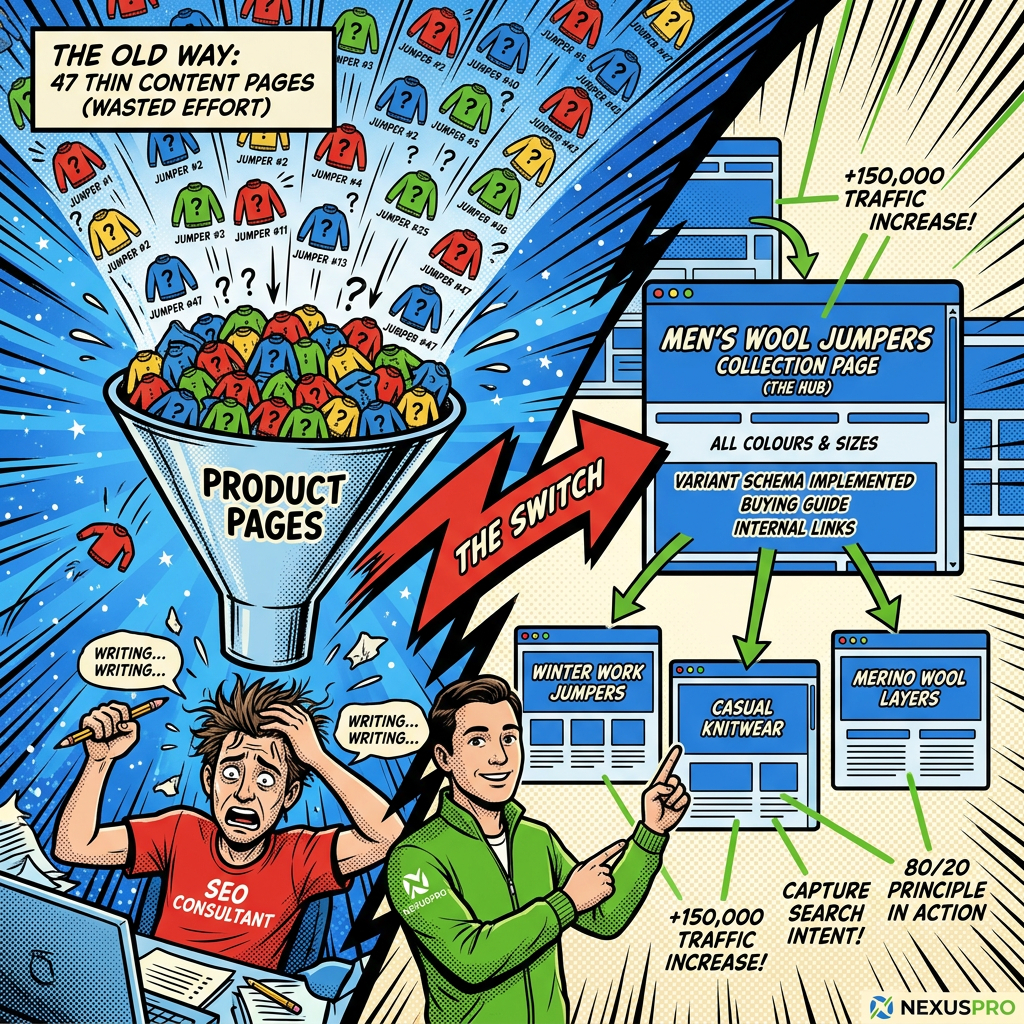
How to Fix Thin Content on E-commerce Product Pages | NEXUSPRO
TL;DR: Stop writing unique descriptions for every product variant. Focus on strategic collection pages, implement variant schema, and build smart internal links. This approach targets how people search and delivers better results with less effort.
Quick Answer:
Group similar products using variant schema instead of creating separate pages for each colour or size
Build collection pages that target how buyers search (by use case, season, price range)
Focus internal links on collection pages, not individual variants
Write authoritative blog content that links to main collection pages
Optimise your top 5% of pages where you'll get 80% of results
You have 47 product pages for the same jumper in different colours. Each page has roughly 50 words. Google flags them as thin content. Your SEO consultant says write unique descriptions for every single one.
Here's the problem: 92% of the lowest-performing e-commerce brands waste months on this approach. They're solving the wrong problem.
What's the Real Problem With Product Variant Pages?
Most e-commerce businesses follow the same pattern.
You write unique content for each colour, size, and style variation. You publish everything. You wait.
Three months pass. Nothing changes.
The issue isn't effort. Individual product pages don't need to rank unless they're signature products.
People don't search for "red jumper size medium". They search for "men's wool jumpers" or "winter knitwear sale".
These searches lead to category and collection pages.
Bottom line: Stop optimising individual variants. Start building collection pages that match search intent.
Why Collection Pages Outperform Individual Product Pages
Most e-commerce sites get this backwards.
They spend resources making every product page perfect whilst category pages sit idle. Yet category pages often generate more organic revenue than individual product pages.
The reason is simple.
Category pages align with how buyers search and compare options. They target broader, high-intent keywords that capture customers earlier in their journey.
When you've got 47 variations of the same jumper, you don't need 47 optimised pages. You need one strong collection page that groups them intelligently.
Each new collection page targets search terms shoppers use. It's a new URL for Google to rank without adding new products to your store.
This is the 80-20 principle in action. Focus your effort on the 20% of pages that deliver 80% of your results.
The takeaway: Collection pages match buyer intent and capture customers earlier in their journey.
How to Use Product Variant Schema
Most businesses miss this opportunity.
Google's expanded support for ProductVariant schema lets you distinguish between different product options within your product markup. You show colours, sizes, and patterns without creating separate pages for each one.
The schema tells search engines which variants are in stock and what options you offer. It makes your products eligible for display with variant information in merchant listing experiences.
Few brands have adopted this yet. That creates an advantage for businesses that implement it.
Group similar products together using variant schema, then write authoritative content on your blog and supplemental pages. These links guide search engines to the main product page whilst providing the depth Google wants.
Key point: Variant schema lets you show product options without creating separate pages for each variant.
How Strategic Internal Linking Builds Authority
Internal linking is where most e-commerce sites fail.
86% of e-commerce brands lack optimised internal links. Even 41% of high-visibility sites suffer from poor internal linking structure.
This represents a massive opportunity.
One retail brand saw a 150,000 annual increase in organic traffic within three weeks of implementing strategic internal links to underperforming product pages. Another e-commerce brand achieved a 23% traffic increase after expanding internal links to deeper category pages.
Your internal links should define what each product, brand, or category represents. The wording you use needs to align with user needs so search engines understand what you sell.
Point your internal links to collection pages, not individual variants. Match compatibility factors like clothing sizes, software versions, or product colours. This creates a clear hierarchy that both users and search engines follow.
The result: Strategic internal linking increases traffic and helps search engines understand your site structure.
How to Build Collection Pages That Drive Traffic
Most merchants have a handful of collection pages for basic navigation. You're missing dozens of opportunities.
Consider all the ways customers search for your products. By use case, by season, by price range, by style, by problem solved.
Each of these is a potential collection page.
A clothing retailer doesn't need "Men's Jumpers". They need "Winter Work Jumpers", "Casual Weekend Knitwear", "Merino Wool Layers", "Jumpers Under £50".
Each collection page targets different search intent. Each one captures customers at different stages of their buying journey.
You're creating new ranking opportunities without adding inventory.
The strategy: Create collection pages for every way customers search for your products.
Where to Focus Your SEO Effort
Stop trying to optimise every product page.
Here's where your effort belongs:
1. Build comprehensive collection pages
Target how people search. Include filtering options, comparison features, and buying guides.
2. Implement variant schema
Help Google understand your product relationships without needing separate pages for every option.
3. Create strategic internal links
Guide both users and search engines through your site hierarchy. Focus on connecting collection pages to relevant products.
4. Write authoritative blog content
Establish expertise in your category. Link from these articles to your main collection pages.
5. Optimise your top 5% of pages
Focus on pages that drive results. These will deliver the majority of your traffic and revenue.
The principle: Do less, but do it well. Focus on the 20% that delivers 80% of results.
What This Approach Requires
This approach needs a shift in how you think about SEO.
You're moving from "optimise everything" to "optimise what matters". From individual products to strategic collections. From hoping Google figures it out to telling Google exactly what you want to rank for.
The businesses that understand this skip writing 47 unique descriptions for identical jumpers. They build collection pages that capture search intent, implement schema that clarifies product relationships, and create internal linking structures that guide customers to what they need.
They focus on the 20% of work that delivers 80% of results.
That's strategy.
Core insight: Focus on strategic pages that match search intent instead of optimising every product variant.
A Practical Example
You've got those 47 jumper variants.
Instead of 47 individual optimised pages, you build:
One main collection page: "Men's Wool Jumpers" with comprehensive content about materials, care, styling, and sizing. This page uses variant schema to show all colour and size options.
Three targeted collections: "Winter Work Jumpers", "Casual Knitwear", and "Merino Wool Layers". Each targets different search intent and links to relevant products.
Two blog articles: "How to Choose the Right Wool Jumper" and "Caring for Merino Knitwear". Both link strategically to your collection pages.
Strategic internal links: From related products, complementary items, and category pages.
You've created five collection pages and two articles instead of optimising 47 individual pages. You've targeted multiple search intents, established authority, and built a clear site structure.
The outcome? Better rankings, more traffic, and less wasted effort.
The proof: Fewer pages, better results, less work.
Frequently Asked Questions
Should I delete all my individual product variant pages?
No. Keep them for shopping purposes. Stop trying to optimise each one individually. Use variant schema to group them and focus your SEO effort on collection pages.
How many collection pages should I create?
Start with 3-5 collection pages for your main product categories. Add more based on how customers search. Look at your search query data to find opportunities.
Won't Google penalise me for thin product pages?
Google doesn't penalise thin content on product pages when you've implemented variant schema and have strong collection pages. The schema tells Google these are variants of the same product.
What's the difference between category pages and collection pages?
Category pages are broad ("Men's Clothing"). Collection pages are targeted ("Winter Work Jumpers"). Collection pages match specific search intent and buying scenarios.
How long does it take to see results from this approach?
Some businesses see traffic increases within 3-4 weeks of implementing strategic internal links. Collection page rankings build over 2-3 months as Google indexes and understands your site structure.
Do I still need unique product descriptions?
Yes, for your main product pages. No, for every colour and size variant. Use variant schema to show options without duplicating content.
Should I combine all variants onto one page?
It depends on your platform and user experience. Some platforms handle this well with variant selectors. Others work better with separate URLs grouped by schema. Test what works for your customers.
How do I know which pages to optimise first?
Look at your analytics. Find pages with decent traffic but poor conversion, or pages ranking on page 2-3 of Google. These are your opportunities. Focus on collection pages that target high-intent keywords.
Key Takeaways
Stop writing unique descriptions for every product variant. Focus on strategic collection pages that match how people search.
Use ProductVariant schema to group similar products without creating separate optimised pages for each colour or size.
Build collection pages for every way customers search: by use case, season, price range, problem solved.
Point internal links to collection pages, not individual variants. This builds authority and helps Google understand your site structure.
Apply the 80-20 principle. Optimise the top 5% of pages that will drive 80% of your results.
Write authoritative blog content that links to your main collection pages to establish expertise and guide search engines.
Less effort on the right pages delivers better results than spreading yourself across every product page.

