

Speed to Lead Is a Buyer Behaviour Insight, and Most Businesses Read It Wrong
TL;DR: Responding to a lead within 5–20 minutes can lift conversion rates by 30–70%. The follow-up process, not the campaign, is where most service businesses lose revenue. Fix speed, consistency, and ownership, and you stop leaving money on the table before a competitor picks it up.
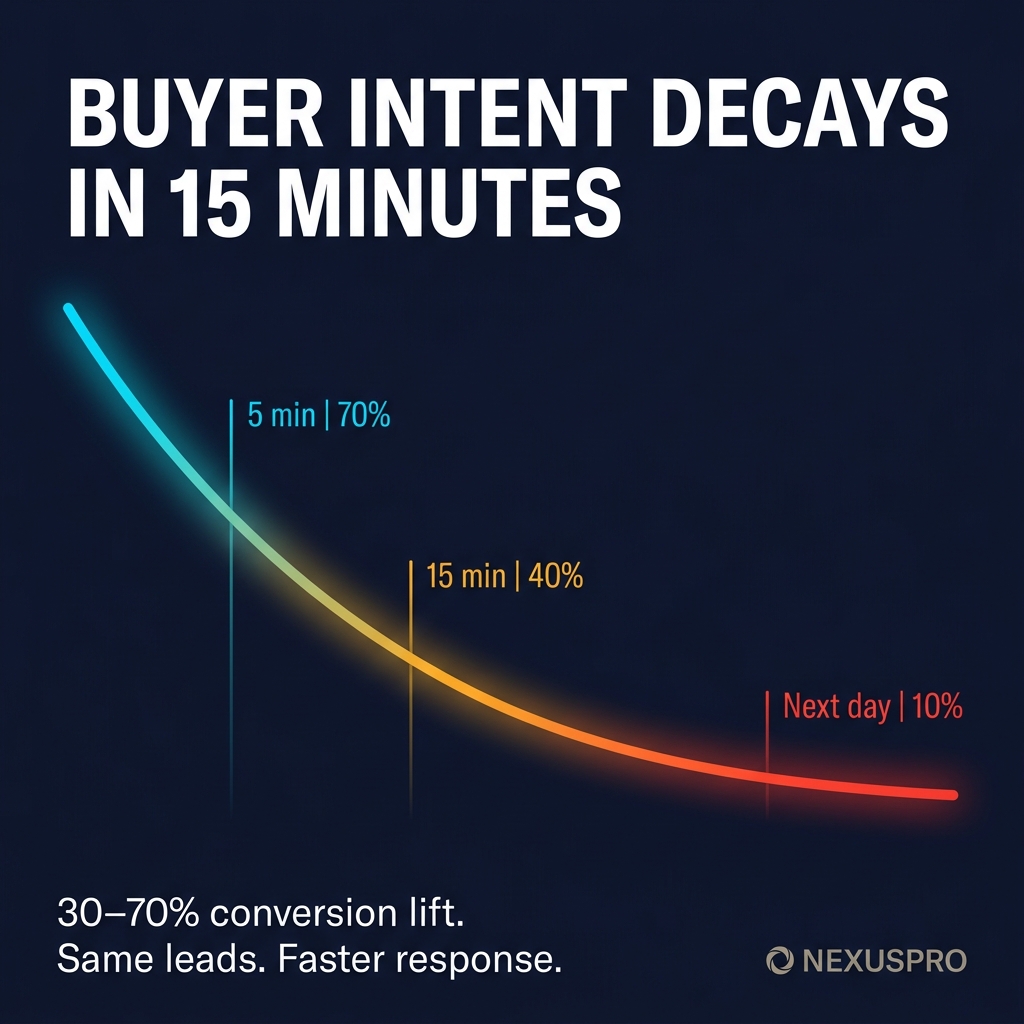
Leads go cold within minutes, not days, because buyer intent drops off fast once the moment passes.
A 5–20 minute response window can increase conversions by 30–70%, without touching your ad spend.
Three things break down after a lead arrives: speed, consistency, and ownership.
Disjointed tools create the gaps. A connected system with automated responses closes them.
Before increasing your acquisition budget, audit what happens in the first fifteen minutes after a lead lands.
Service businesses run solid marketing campaigns. Enquiries arrive. Then the lead sits in a queue until someone opens the CRM the next morning, and by then it is gone. Budget gets pulled. The campaign takes the blame.
That is the wrong diagnosis, and it costs businesses money every week.
The research is clear. When a system responds to a lead within the first five, ten or fifteen minutes, conversion rates rise anywhere between 30 and 70 per cent. No better targeting. No extra spend. Just being first.
Why the Campaign Gets Blamed When the Follow-Up Failed
A team runs paid ads. Enquiries land. Conversion rates disappoint. So the budget gets cut and the channel gets questioned. Rarely does anyone ask what happened in the twenty minutes after the form was filled in.
The follow-up is where the money goes missing, and it is easy to overlook because campaigns are visible and follow-up processes usually are not.
I have worked with small service businesses in marketing and technology for many years, and this is the thing that keeps showing up. The leads are fine. The follow-up is not.
Key point: Weak conversion rates are usually an operational problem, not a campaign problem.
Why Does the 15-Minute Window Matter So Much?
Psychology, more than sales process, explains this.
Someone who fills in your enquiry form has carved out time, framed their problem and taken action. Their intent is at its highest point right then. By the next morning their context has shifted. Priorities have moved. In many cases, they have already spoken to a competitor who picked up faster.
Buyer intent drops off fast. The fifteen-minute window reflects just how quickly expressed interest fades. Respond inside it and you meet the buyer while the problem still feels urgent. That is the behavioural truth underpinning the numbers, and it is why response speed outperforms almost any campaign tweak you can buy.
Key point: Speed to lead is a buyer psychology issue. The window is short because urgency is short.
Where the Leak Actually Happens
Three things break down after a lead arrives, and they usually break down together.
Speed. Leads land in an inbox or spreadsheet and wait for a human. Small service businesses typically spend fewer than five hours a week on their marketing, so that wait stretches into days.
Consistency. One attempt gets made, nobody answers, and the follow-up stops. There is no automated cadence to hold the conversation open.
Ownership. Nobody has been named as the person accountable for the lead between form-fill and first conversation. Marketing assumes sales has it. Sales assumes marketing qualified it. The lead dies in a forgotten spreadsheet.
Address all three and you have a working system. Address one and you have plugged a single hole in a bucket with several.
Key point: Speed, consistency, and ownership are the three failure points. Fixing only one is not enough.
How to Fix It: What to Do This Week
Start with an honest audit. Three questions will show you where the leak is.
How fast do you respond? Time it from form submission to first contact. Measure in minutes, not intentions.
How many times do you follow up? One attempt is where most sequences end and most revenue disappears.
Who owns the lead? Name one person or one automated process. Shared ownership means no ownership.
Then build the simplest fix possible. An automated acknowledgement within minutes of the enquiry landing. A short follow-up cadence that runs until the lead replies or opts out. A named person who takes the human conversation from there.
Key point: The audit takes one day. The fix, for most service businesses, takes one week.
Why Disjointed Tools Make This Worse
A form here, an email platform there, a CRM nobody updates consistently. Every gap between systems is a place where a lead sits unanswered. Pulling everything into one connected system removes those gaps and lets an instant response fire the moment an enquiry arrives.
The 80/20 principle applies directly here. Of all the marketing improvements available to a service business, instant lead response sits in the 20 per cent that produces most of the return. It costs a fraction of a new campaign and compounds with every enquiry you receive.
Key point: Consolidating tools is not about software preference. It is about closing the gaps that lose leads.
The Qualification Layer Most Businesses Skip
There is something that should happen even before the follow-up process kicks in, and fewer than 10 per cent of the businesses I work with have it in place.
A basic enquiry form that collects a name, email address and what someone is looking for is the minimum. A better form starts qualifying the lead from minute one. If you run a landscaping business, ask about budget. Ask how urgent the project is. Ask what the goal is.
That information changes everything. It means the follow-up can be bespoke to that lead rather than one-size-fits-all. A high-budget, urgent enquiry gets a different response to a vague, low-priority one. AI tools now make this qualification process significantly more sophisticated, but even a well-structured form does most of the heavy lifting.
The qualification process actually starts earlier than the form. Your website copy, your social media, the quality of your work you put on show, all of this attracts the right prospect and discourages the wrong one before they ever fill anything in. Most business owners have not thought about their marketing that way.
Key point: Qualification starts at the website and continues through the form. Both stages shape who arrives and how you respond.
Simplicity Is the Point
Complexity breeds chaos and inefficiency in follow-up more visibly than anywhere else in marketing. Service businesses that convert well are not running the cleverest campaigns. They answer fast, follow up consistently, and they know exactly who is responsible for every enquiry.
Before adding budget to acquisition, look at the fifteen minutes after someone raises their hand. That is where the growth is.
Key point: Operational simplicity in follow-up produces more measurable return than most campaign-level improvements.
Key Takeaways
Responding within 5–20 minutes of a lead arriving can lift conversion rates by 30–70%.
The campaign is rarely the problem. The follow-up process after the lead lands is where revenue goes missing.
Speed, consistency, and named ownership are the three components of a working follow-up system.
Disjointed marketing tools create gaps where leads go unanswered. Connected systems close them.
Lead qualification starts at the website and continues through the enquiry form, before a human ever makes contact.
The 80/20 principle holds here: instant lead response is one of the highest-return improvements a service business can make.
Audit your current response time, follow-up sequence, and lead ownership before increasing acquisition spend.
Frequently Asked Questions
Why does responding to a lead within 15 minutes matter so much?
Buyer intent is at its highest the moment someone submits an enquiry. Within minutes, context shifts, priorities move, and competitors may already be in contact. Responding inside the 15-minute window means meeting the buyer while their problem still feels urgent.
What conversion rate improvement can I expect from faster lead response?
Research consistently points to a 30–70% lift in conversion rates when a system interacts with a lead within the first 5–20 minutes. The exact figure depends on the industry and how broken the current process is, but the direction is consistent.
Is this a technology problem or a people problem?
Both. A skilled salesperson develops their own follow-up habits and rarely lets a lead go cold. A less experienced team member needs tighter processes around them, or automated systems to handle the immediate response. The answer depends on who is handling the lead.
What is the minimum viable follow-up system for a small service business?
An automated acknowledgement within minutes of an enquiry landing, followed by a simple cadence on day one, day three, and day five. This could be SMS, email, or both. It is significantly better than waiting for a human to find time.
What does lead ownership mean and why does it matter?
Lead ownership means one named person or one defined automated process is responsible for moving the lead from form-fill to first conversation. Without that, marketing assumes sales is handling it and sales assumes marketing qualified it. The lead sits unanswered.
How do disjointed marketing tools affect lead follow-up?
Each gap between systems, a form that feeds one place, an email platform that sits elsewhere, a CRM that nobody updates, is a place where a lead can fall through. A connected system with automated triggers removes those gaps and ensures every enquiry gets an instant response.
How do I qualify leads before a human ever speaks to them?
Build qualifying questions into your enquiry form. Ask about budget, urgency, and goals. This allows your follow-up to be tailored to the lead rather than generic. AI tools can take this further, but a well-structured form handles most of the work.
Should I fix my follow-up process before I increase my ad spend?
Yes. Increasing acquisition spend while the follow-up process is leaking means paying to generate leads that will go unanswered. Fix the follow-up first, then scale the acquisition once you know each lead is being handled properly.