 NexiAI
 CleoAI
 VoxAI
VoxAI OttoAI
 RingoAI
 CallumAI
 WinnieAI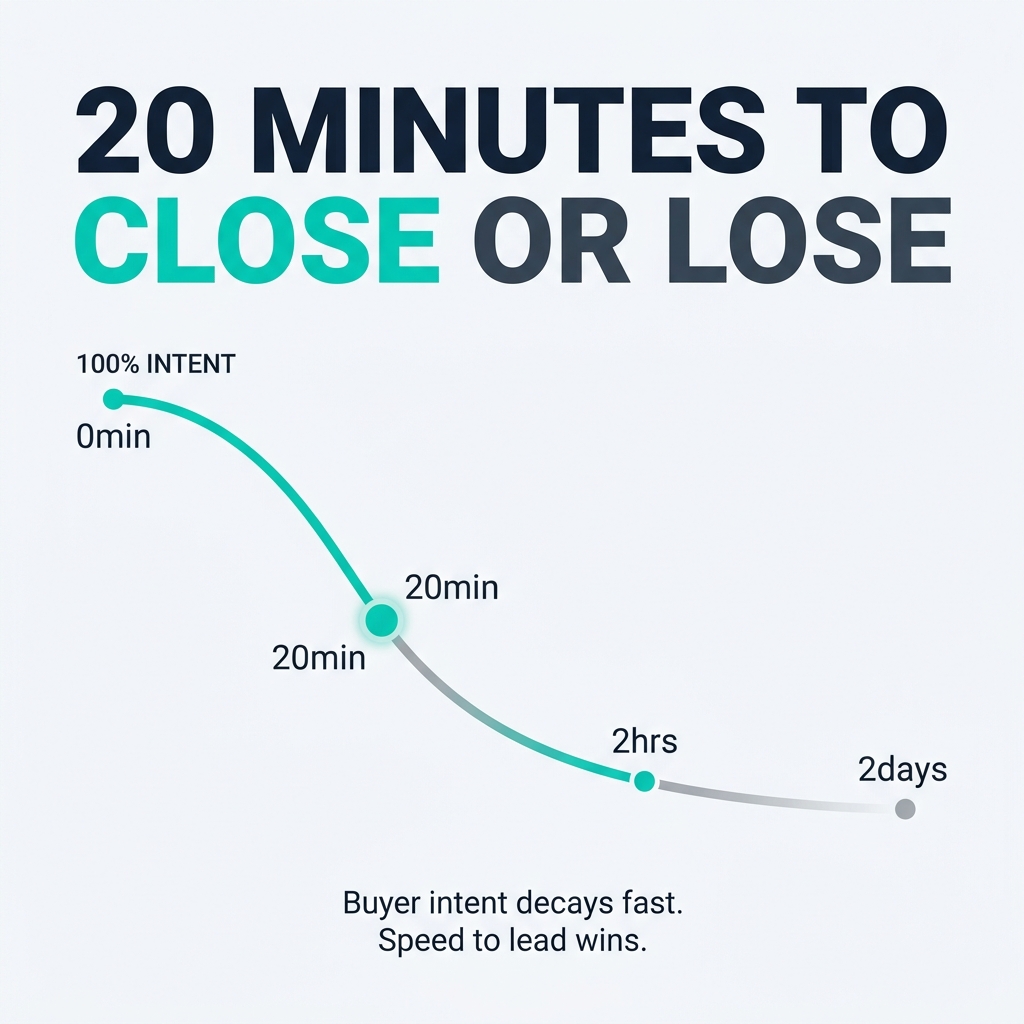
The Founder Is the Bottleneck: Why Your Leads Go Cold While You're On the Tools
TL;DR: Service business leads go cold because the founder is the follow-up process, and founders are always busy. The fix is speed, a defined cadence, and handing ownership to someone or something else. Your marketing is probably working. Your follow-up isn't.
The short version:
The critical window is the 20 minutes after a lead comes in. After that, intent fades fast.
In most small service businesses, follow-up sits with the founder, and founders are juggling five other things.
Cutting ad spend to fix poor conversions is solving the wrong problem.
A simple automated sequence (day 1, day 3, day 5) beats silence every time.
Clear ownership of every lead, by a person or a system, is the single biggest lever most businesses aren't pulling.
Generating the Lead Is Only Half the Job
The enquiry lands. Then nothing happens for two days.
When I dig into why, it's rarely the campaign. It's the follow-up. And in most small service businesses, follow-up is sitting in one person's inbox: the owner.
The uncomfortable truth is this. The person most motivated to close is also the most likely to drop the ball, because they're the one on-site, quoting jobs, managing staff, solving problems. Somewhere in that pile, "reply to new enquiries" is waiting.
A lead comes in at 10am Tuesday. The founder is on the tools. By Thursday evening, that lead has spoken to two competitors.
The marketing didn't fail. The lead wasn't owned in the hours after it arrived. That's a different problem entirely, and it needs a different fix.
Key Point: Lead generation gets all the attention. Lead follow-up is where the revenue actually leaks.
Why the 20 Minutes After Capture Are the Most Important
Buyer intent fades quickly. Someone who fills in a form has framed their problem, carved out time and taken action. They are in the moment right then. By the next morning, priorities have shifted and life has moved on.
The critical window is the 20 minutes after capture.
A same-day response reads as competence. A two-day silence reads as a signal about how the rest of the business probably runs, too.
Lead capture tools are widely available and largely interchangeable now. The competitive edge has shifted to what happens immediately after the form is submitted. Speed to lead outperforms another website feature, every time.
The Misdiagnosis That Costs Businesses Money
When conversion rates disappoint, the campaign takes the blame. Budgets get cut. Channels get killed. The agency gets fired.
Businesses pour more budget into ads to fix a problem that lives in their follow-up process. That is buying more water for a leaking bucket, and calling it a growth strategy.
Before you touch your marketing budget, answer one question honestly: who owns the lead between the form-fill and the first human contact?
If the answer is "me, when I get a minute", you have found your leak. Ambiguous ownership sends leads to sit in a forgotten spreadsheet until they stop mattering.
The Wake-Up Call Comes When Someone Else Takes Over
The moment of clarity arrives when ownership moves. An admin assistant gets the job of touching every lead within the hour. Or an automated system sends the first response instantly and books the call.
Suddenly every lead gets a reply. Conversions lift. And the founder realises the marketing was working all along.
The constraint was organisational. Clear accountability beats sophisticated software. Always.
Key Point: You don't need better technology to fix this. You need better ownership. That distinction will save you a lot of money.
Fix It With Speed, Consistency and Ownership
Effective follow-up rests on three things:
Speed. An instant acknowledgement, even automated, keeps the lead warm while a human catches up.
Consistency. A defined cadence: day 1, day 3, day 5. One attempt is not a process.
Ownership. A named person or system accountable for every lead. If everyone owns it, nobody owns it.
This aligns with the 80/20 principle I apply across marketing. Follow-up is the 20% of activity that produces 80% of your conversion results. Fix it before spending another pound on acquisition.
You do not need enterprise complexity to do this. A simple automation that fires within minutes, a short follow-up sequence and one accountable person will outperform an expensive tech stack with no defined process.
Key Point: Speed + Consistency + Ownership. Three things. That is the entire follow-up framework for a small service business.
Step Out of the Bottleneck
If you are the founder still chasing your own leads, the instinct makes complete sense. Nobody understands or sells your business the way you do. But a slower, stretched-thin you loses to a faster, focused system week after week.
Your job is to design the follow-up process. Someone or something else should run it.
Audit your last 20 enquiries. Note how long each one waited for a first response and who touched it. This exercise commonly reveals more lost revenue than any campaign report will.
Simplify the process, assign the ownership and protect those 20 minutes after capture. Your marketing is likely working harder than your follow-up allows it to show.
Key Point: Founders design systems. They don't run them. The moment you remove yourself from the follow-up loop is the moment your conversion rate tells the truth.
Frequently Asked Questions
How quickly should I follow up with a new lead?
Within 20 minutes where possible. Studies suggest that responding within the first 5 to 20 minutes can push conversion rates up by 30 to 70 percent compared to waiting hours or days. Even an automated acknowledgement in that window keeps intent alive.
What is the minimum follow-up system a small business needs?
A basic CRM with an automated sequence covering day 1, day 3 and day 5 is the starting point. That might be an automated SMS, an automated email, or both. It is far better than silence, and it ensures every lead is handled consistently regardless of how busy the owner is.
Why do founders become the bottleneck in lead follow-up?
Because they are running the business at the same time. Quoting, delivering work, managing staff and handling admin all compete for the same attention. Lead follow-up rarely feels urgent until a deal is visibly lost, and by then it is too late.
Should I fix my ad campaign or my follow-up process first?
Diagnose the follow-up first. If leads are coming in but not converting, the campaign may be doing its job. Cutting ad spend before auditing follow-up is solving the wrong problem. Once follow-up is working, then assess campaign performance on its own merits.
What does lead qualification have to do with follow-up?
Qualification at the point of capture changes everything about how you follow up. A form that asks about budget, urgency or project goals tells you immediately whether a lead is high priority or low priority. That lets you follow up differently with different leads, rather than treating every enquiry the same way.
How does automation help with lead follow-up?
Automation handles the immediate response and the follow-up cadence without relying on a person to remember. It keeps the lead warm, maintains contact at defined intervals and ensures nothing falls through the cracks. It is not a replacement for human conversation; it buys time until a human can engage properly.
What is the role of AI in the lead follow-up process?
AI can now handle initial qualification conversations at the point of enquiry, asking the right questions before a human ever gets involved. This means that by the time a salesperson or business owner engages, the lead has already been pre-qualified and the follow-up can be far more targeted and relevant.
How do I know if my follow-up process is broken?
Audit your last 20 enquiries. Record the time between form submission and first contact, who made that contact and how many follow-up attempts followed. If leads waited more than an hour, if only one attempt was made or if ownership is unclear, the process needs work.
Key Takeaways
The real conversion problem in most service businesses sits in the 20 minutes after a lead is captured, not in the campaign that generated it.
Founders are the most motivated person to close, and the most likely to miss the follow-up window because they are running the entire business simultaneously.
Cutting ad spend to fix conversion rates is the wrong move if follow-up is the actual leak. Diagnose before you cut.
A day 1, day 3, day 5 automated sequence is the minimum viable follow-up system. It outperforms nothing, every time.
Clear ownership of every lead, by a named person or a defined system, is more valuable than advanced software with no accountability attached.
Lead qualification starts at the form, not the phone call. Ask the right questions at capture and your follow-up becomes smarter and more targeted immediately.
Speed, consistency and ownership. Get those three right and your existing marketing will almost certainly perform better than it does today.

