 NexiAI
 CleoAI
 VoxAI
VoxAI OttoAI
 RingoAI
 CallumAI
 WinnieAI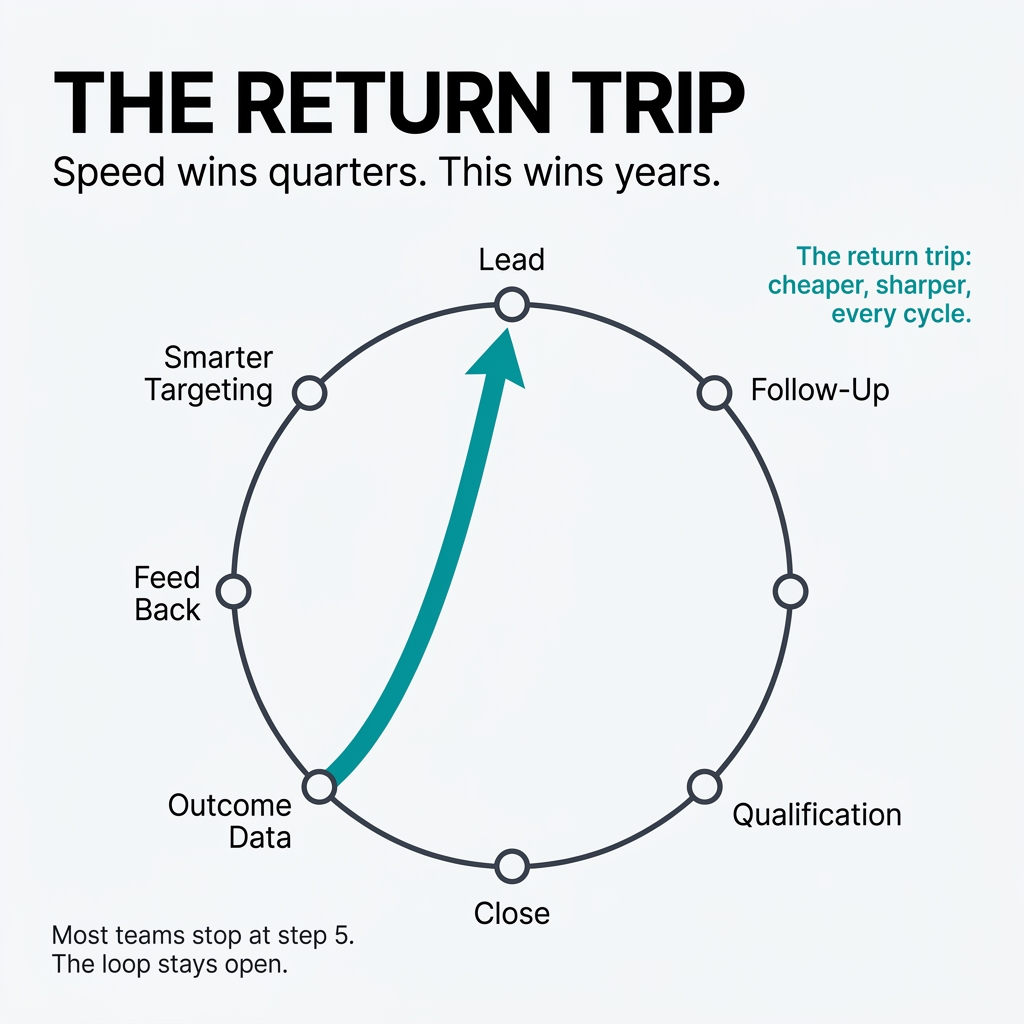
The Return Trip: Why the Smartest Marketing Teams Feed Sales Outcomes Back Into Targeting
TL;DR: Fixing follow-up speed is table stakes. The teams pulling ahead are feeding closed-won and closed-lost data back into their targeting — a feedback loop called the "return trip" that makes every future ad spend smarter and cheaper. Here's how it works and how to start.
The biggest lead generation leak is post-capture, not at the top of the funnel.
Speed to lead (within 5–20 minutes) can lift conversion rates by 30–70%.
The "return trip" closes the loop: outcome data flows back into ad targeting and form qualification.
This creates a compounding effect — better lead quality and lower cost per lead every cycle.
Fewer than 10% of service businesses have this feedback loop in place.
What Is the Return Trip — and Why Does It Matter?
A LinkedIn post by Kathleen Booth sparked over 1,048 comments. An analysis of 720 substantive responses showed near-universal agreement: the lead generation leak sits after the form fill, in the follow-up process (289 mentions) and in speed to lead (235 mentions). As one commenter put it, "generating the lead is only half the job."
Getting faster at follow-up matters. I coach service businesses on it constantly. But buried in that same thread was a far more valuable idea — one that only a handful of commenters raised.
John Gusiff called it the return trip. In my view, it separates teams that improve one quarter from teams that improve every quarter.
Key Point: The conversation has already identified the problem. The follow-up leak is real and well-documented. The return trip is the next layer most teams haven't touched yet.
How Does the Return Trip Work?
Here is the concept in plain terms.
Most teams treat their funnel as a one-way street. Ads generate leads, leads go to sales, deals close or they don't, and the cycle resets from scratch.
The return trip closes that loop. You take your closed-won and closed-lost data and feed it back into two places:
Audience targeting. Your ad platforms learn from the leads that became revenue, so they find more people like your best customers.
Form qualification. Your capture questions evolve to filter for the traits that predicted a win.
Think of it this way. One team gets faster at follow-up and closes more of what it captures. Another team does the same, then also feeds outcomes back into targeting. The first team closes more this quarter. The second team pays less for better leads every quarter after that.
Speed gives you a better quarter. Feeding outcomes back into targeting gives you a compounding advantage that builds over time.
Key Point: The return trip is a feedback loop, not a feature. It works because outcome data teaches your targeting what winning actually looks like.
Why Do So Few Teams Actually Do This?
The return trip appeared in only a small number of comments across a thread of more than a thousand. That tells you a lot about where the market is right now.
Three reasons come up consistently in the service businesses I work with.
Disconnected tools. Outcome data lives in the CRM. Targeting lives in the ad platform. When those systems never talk to each other, the loop stays permanently open. This mirrors the wider thread finding — 181 comments pointed to CRM, ownership and tooling gaps as the root issue.
Unclear ownership. Marketing owns the top of the funnel. Sales owns the close. As commenters put it, they operate like "two roommates who never talk to each other." Nobody owns the return journey.
Complexity fatigue. Service business owners running on fewer than five hours of marketing per week feel they have no room for another process. This is where the 80/20 principle earns its keep. The return trip sits squarely inside the 20% of activity that produces 80% of the improvement — because it makes every future pound of ad spend smarter.
💡 Tip: you already have the data. Every closed deal and every lost deal is a lesson your targeting has never been taught.
Key Point: The return trip fails most often because of organisational gaps, not technical ones. Ownership and connectivity matter more than clever software.
Has Lead Capture Already Been Solved?
The thread reached a striking consensus, summed up by commenter Srikanth Inuganti:
"The capture side is solved territory at this point. The gap I keep seeing is the 20 minutes after."
Form builders and landing pages are now commodities. The competitive advantage has migrated to the operational layer: response speed, follow-up consistency, clear ownership, and the attribution loop.
The 20-minute window reflects real buyer behaviour. Someone who fills in a form is mentally present in that moment. By the next morning, priorities have shifted and inertia has set back in. Intent fades fast.
Fix speed first. Then recognise that speed alone is the entry fee. The return trip is where the advantage compounds — a team that improves lead quality every cycle spends less to win more, quarter after quarter.
Key Point: Lead capture is a commodity. The advantage now lives in what happens after the form is submitted — and in what you do with the outcome data from every deal.
How to Start Your Own Return Trip
You need a working feedback loop before you need clever software. Here is the sequence I recommend to service business owners.
Connect your CRM to your ad platforms. Closed-won and closed-lost outcomes must flow back to where targeting decisions get made.
Tag every closed deal with its original source and campaign. Without this, the loop teaches nothing.
Review outcomes monthly. Look for the traits your wins share: industry, deal size, form answers, response time.
Adjust targeting and form questions based on what you learn. One change per cycle keeps it manageable.
Assign a named owner for the loop. The thread made this clear: accountability beats tooling sophistication every time.
Simplicity is non-negotiable. Complexity breeds chaos, and this loop only works when it stays simple enough to run every month without a specialist.
Speed to lead won the conversation this year. Feeding outcome data back into targeting will determine who wins the next three. Start now and you build something your competitors will find genuinely hard to copy: a marketing system that gets cheaper and sharper with every cycle.
Key Point: The return trip runs on five steps. The one that gets skipped most often is assigning a named owner. Without accountability, the loop dies before it starts.
Frequently Asked Questions
What is the return trip in marketing?
It is the practice of feeding closed-won and closed-lost sales data back into your ad platform targeting and lead capture forms, so future leads cost less and convert better.
How quickly should you follow up on a new lead?
Studies cited in practitioner discussions suggest responding within 5 to 20 minutes can lift conversion rates by 30 to 70%. Intent fades quickly after a form is submitted.
Why does speed to lead matter so much for service businesses?
Service business buyers are often comparing multiple providers at once. The business that responds first sets the frame for the conversation. Slower responses hand that advantage to a competitor.
What data should you feed back into targeting?
At minimum: closed-won deals, closed-lost deals, original lead source, and campaign tag. Over time, add form answer traits, deal size, and industry. Start simple.
How do you connect a CRM to an ad platform for the return trip?
Most major CRMs support native integrations or API connections to platforms like Google Ads and Meta. The key is tagging lead source at capture so the data flows in a usable format.
What if my team does not have the capacity for another process?
Apply the 80/20 principle. The return trip is a monthly review, not a daily task. One cycle of feedback and one targeting adjustment per month is enough to start seeing compounding results.
Who should own the return trip process?
Assign one named person. In most small service businesses that is the marketing lead or the founder until volume justifies a dedicated role. Shared ownership usually means no ownership.
Is lead qualification part of the return trip?
Yes. As you learn more about what a winning lead looks like, your form questions should evolve to filter for those traits earlier. The form becomes the first step in the sales conversation, not just a data capture point.
Key Takeaways
The follow-up process, not the ad campaign, is where most service business leads are lost.
Responding within 5–20 minutes can increase conversion rates by 30–70%, based on practitioner-cited research.
The return trip is a feedback loop that feeds sales outcome data back into targeting and form qualification.
Speed to lead is the entry fee. The return trip is the compounding advantage that builds over time.
Disconnected tools, unclear ownership, and complexity fatigue are the three reasons most teams never close the loop.
The 80/20 principle applies directly: the return trip is a small monthly process that improves the efficiency of all future ad spend.
Assign a named owner. Without accountability, the loop will not run consistently enough to produce results.

