

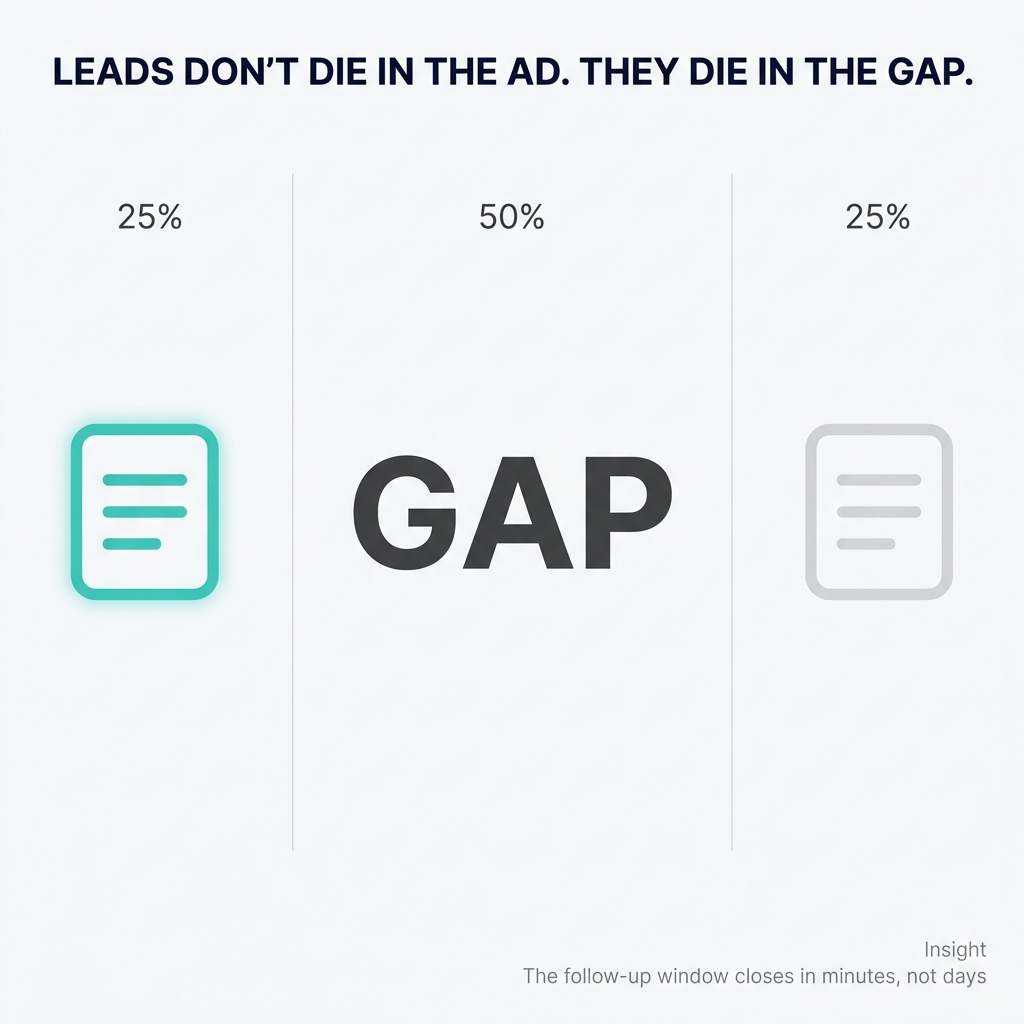
Your CRM Is Not the Problem. Your Follow-Up Is.
TL;DR: Service businesses lose most of their leads after capture, not before. Slow or absent follow-up is the conversion killer, and a basic automated sequence fixes the majority of it.
Leads go cold within minutes of form submission, not hours.
Automated first contact (SMS + email within five minutes) can lift conversion rates by 30–70%.
A day-one, day-three, day-five follow-up cadence is the minimum viable system.
Lead ownership must be named. Unassigned leads almost never get followed up.
Fix the follow-up before spending more on ads.
Why Your Campaigns Aren't the Problem
Service business owners reach out to me after cutting their ad budgets. The leads weren't converting, so the campaign got the blame. That diagnosis is usually wrong.
A LinkedIn post from Kathleen Booth pulled over 1,000 comments on exactly this. The majority of respondents agreed: generating the lead is only half the job. The failure happens in the 20 minutes after.
Someone fills in a form. Then nothing happens for a day. Sometimes two. By the time a human picks up the phone, the moment has passed. The prospect moved on.
The ad budget wasn't the problem. The follow-up was.
Bottom line: Before adjusting your campaigns, audit what happens to the leads you already generate.
How Fast Is Fast Enough?
Think about what the person who just filled in your form is doing in that moment. They carved out time, framed their problem and took action. You have their full attention right then.
By the next morning, context has shifted. Other priorities have moved in. Intent decays fast, and the window to respond while it's still warm is measured in minutes, not days.
Studies vary in their precise numbers, but the directional finding is consistent: responding within five to fifteen minutes can push conversion rates up anywhere between 30 and 70 percent compared to responding the next day. That's not from a better campaign. Just from being quicker.
For small service businesses where owners spend fewer than five hours a week on marketing, you'll lose the race to respond manually every time. Automation removes the race entirely.
Speed to lead isn't a tactic. It's the single highest-leverage fix most service businesses haven't made yet.
The Minimum Every Business Should Have in Place
Here's what I consider the baseline:
An automated SMS sent within five minutes of every enquiry.
An automated email in the same window.
A follow-up sequence: day one, day three, day five.
Every lead handled the same way, regardless of who is in the office.
That setup costs very little to build. It runs without anyone remembering. And it already beats what most small service businesses currently have, which is a spreadsheet and good intentions.
To be clear: that is the floor. Plenty of businesses haven't laid it yet.
A CRM without a defined follow-up process is a filing cabinet for missed opportunities.
What Most Businesses Get Wrong Before the Follow-Up Even Starts
Here's something worth addressing before the follow-up conversation: the quality of the capture itself.
If your enquiry form just asks for a name, email and rough description of the job, you're treating every lead as identical. But they're not. A landscaping business that asks about budget, urgency and goals on the form already knows something useful before anyone picks up the phone.
That qualification step changes the entire follow-up. A high-budget, urgent lead gets a different response than a price-shopping enquiry. And the form can do that work automatically, even before an AI or a human gets involved.
Fewer than 10% of the businesses I work with have this thinking built in when they come to me. The other 90% treat the form as a data collection task. It's actually the first move in the sales conversation.
Lead qualification starts at the form, not at the first call.
Why Ownership Breaks Down
Ask your team this: when a lead comes in, who owns it between form submission and first human contact?
In a lot of businesses, the honest answer is nobody. Marketing considers the job done once the lead lands. Sales considers it theirs once it's qualified. Between those two views, leads sit in a CRM going cold.
Fixing this costs nothing. Name a person. Define the handover. Write down the expected response time. Let your automation cover the gap when that person is on a job site.
The founder is often the bottleneck here. They're the most motivated to close and the most likely to drop the ball because they're also solving problems in the field, managing staff and running the business. Taking the founder out of the lead follow-up loop is one of the highest-leverage moves a growing service business can make.
Defined accountability matters more than advanced tooling. Name the owner, write the process, then build the system around it.
How to Apply the 80/20 Principle to Your Follow-Up
80% of your conversion results will come from 20% of your follow-up actions. Most businesses spread effort across too many tools and too many half-built sequences. Here's where to focus:
Instant automated response. SMS and email within five minutes of every enquiry.
Simple cadence. Day one, day three, day five. Keep it human in tone, not corporate.
Named lead owner. One person accountable for every lead until it converts or closes.
Weekly review. Count the leads that got no follow-up. The target is zero.
None of this needs enterprise budgets. It needs a decision to treat follow-up as a system.
Simplicity compounds. Four steps done consistently beat twelve steps done occasionally.
Stop Buying More Leads Until You Fix This
Before spending another pound on advertising, audit what happens to the leads you already generate. The businesses that grow consistently fix the leak first, then scale the flow.
Get the strategy straight. Put the simple system in place. Give every enquiry the same fast, consistent handling. The marketing you already run starts paying for itself.
The leads are coming in. Make sure something is there to catch them.
Frequently Asked Questions
How quickly should a business respond to a new enquiry?
Within five to fifteen minutes where possible. Intent decays rapidly after form submission. An automated SMS or email in that window holds the lead warm until a human can follow up properly.
What if I don't have a CRM yet?
Start with a basic CRM that supports automated messaging. The day-one, day-three, day-five cadence is achievable on most entry-level platforms. The tool matters less than having any consistent process at all.
Is this really a follow-up problem, or is my campaign actually underperforming?
Both can be true. But in most cases I work through, the campaign is generating leads at a reasonable cost per lead. The conversion failure happens post-capture. Fix the follow-up first, then assess the campaign with clean data.
What should the automated messages actually say?
Keep them human in tone. Acknowledge the enquiry, confirm you've received it, set an expectation for when a person will be in touch, and give them a reason to stay engaged. Avoid templates that read like a bulk mailout.
Who should own the leads in a small service business?
Name one person. In smaller teams, that's often a dedicated admin or sales coordinator. Taking the founder out of day-to-day lead handling is important because founders are the most likely to get pulled away and drop the ball, not from lack of motivation but from competing demands.
How do I qualify leads at the capture stage?
Add two or three questions to your enquiry form: budget range, urgency, and what outcome they're looking for. This lets you segment leads immediately and tailor the follow-up sequence to their situation rather than treating all enquiries the same.
What's the difference between a good follow-up sequence and an annoying one?
Relevance and tone. A sequence that acknowledges what the person asked about, speaks to their situation, and adds something useful feels helpful. A sequence of generic check-ins that ignore the original enquiry feels like spam.
When does it make sense to invest more in ad spend?
After the follow-up system is working. Scaling ad spend into a broken follow-up process wastes the budget. Once you can demonstrate that leads are being contacted quickly, followed up consistently, and converting at a reasonable rate, scaling becomes a straightforward decision.
Key Takeaways
Lead conversion fails most often in the follow-up stage, not at the campaign level.
Responding within five to fifteen minutes of form submission can lift conversion rates by 30–70%.
A day-one, day-three, day-five automated cadence is the minimum viable follow-up system.
Lead ownership must be explicitly assigned. Ambiguity is where leads die.
Lead qualification starts at the form, not at the first call.
Founders are often the bottleneck in lead follow-up and should be removed from that role as the business grows.
Fix the follow-up before increasing ad spend. Scale what's working, not what's leaking.