 NexiAI
 CleoAI
 VoxAI
VoxAI OttoAI
 RingoAI
 CallumAI
 WinnieAI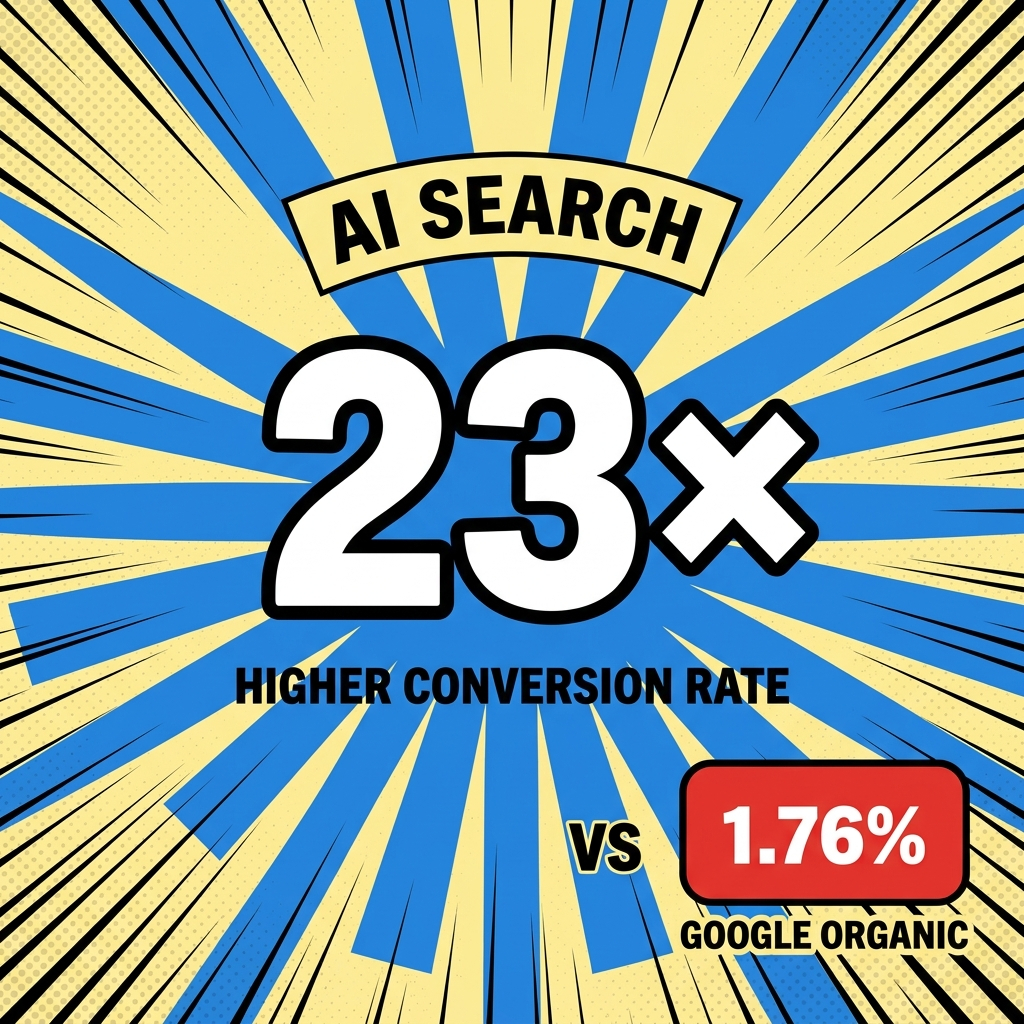
Your SEO Strategy Just Became Irrelevant: Only 15% of Retrieved Pages Get Cited
TL;DR: Traditional SEO is losing effectiveness as AI search transforms digital marketing. Between 2024 and 2025, 73% of B2B websites lost significant traffic, with AI Overviews reducing clicks by up to 58%. The opportunity: brands cited in AI results earn 35% more organic clicks and see conversion rates 23 times higher than traditional search. Success now depends on creating comprehensive, fact-rich content that AI systems cite, not just content that ranks.
What You Need to Know:
AI Overviews now reduce clicks to top-ranking pages by 58% on average
Brands cited in AI results earn 35% more organic clicks and 91% more paid clicks
AI search traffic converts at 15.9% compared to Google's 1.76% organic rate
Articles over 2,900 words average 5.1 citations versus 3.2 for shorter content
You have roughly three years before AI search overtakes traditional search for most topics
I've spent 20 years in marketing, working with service businesses doing $1M to $10M in revenue.
The foundation of digital marketing shifted. Most business owners haven't noticed. They're still playing by old rules whilst the game changed around them.
Here's what the data shows.
What's Happening to Organic Traffic Right Now
Between 2024 and 2025, 73% of B2B websites saw significant traffic losses. The average decline hit 34% year-over-year.
This isn't a dip.
Service businesses that spent years building search rankings are losing more than half their traffic. Some sectors saw organic traffic drop between 15% and 64% since AI Overviews launched.
The businesses I work with aren't small operations. They're established service companies doing $1M to $5M in revenue. They built their marketing on Google traffic.
Now that traffic is disappearing.
Here's what should concern you.
Ranking number one no longer guarantees traffic. Click-through rates for Google's top-ranking search result dropped from 28% to 19%. That's a 32% decline correlating directly with AI Overviews expansion.
You rank first. You still lose.
The Reality: Traditional ranking positions no longer guarantee visibility or traffic because AI Overviews intercept users before they click through to websites.
Why Your Top Rankings Aren't Delivering Clicks Anymore
AI Overviews now correlate with a 58% lower average click-through rate for top-ranking pages as of December 2025.
For every 100 clicks your business historically earned from a top-ranking page, Google now keeps 58.
The numbers get worse for informational queries:
Organic click-through rates for informational queries with Google AI Overviews fell 61% since mid-2024
Paid clicks on those same queries dropped 68%
An estimated 58% to 60% of Google searches in 2025 are zero-click searches
Users get the answer directly from search results. They never visit your website.
Your optimised content sits there. Indexed. Ranked. Ignored.
The Reality: Zero-click searches mean your content feeds AI answers without sending traffic to your site, breaking the traditional SEO value chain.
The Hidden Opportunity in AI Search
I don't dwell on problems. I focus on solutions.
The data reveals something most people are missing. There's an opportunity hiding inside this disruption.
Brands cited in AI Overviews earned 35% more organic clicks and 91% more paid clicks than those not cited.
When your brand appears in AI-generated results, organic click-through rates jump 35% higher.
The businesses that figure out how to get cited win. The ones that don't become invisible.
This validates something I've believed for years. The 80/20 principle applies here more than anywhere else.
20% of your content will drive 80% of your results. Now that 20% needs to be good enough to get cited by AI.
The Reality: Getting cited by AI systems creates a multiplier effect, delivering both higher visibility and superior traffic quality compared to traditional ranking alone.
How AI Search Traffic Converts Differently
Here's where this becomes compelling for business owners.
Traffic from AI search converts at higher rates than traditional organic search.
The conversion rates tell the story:
ChatGPT traffic: 15.9%
Perplexity: 10.5%
Claude: 5%
Gemini: 3%
Google organic: 1.76%
AI-referred visitors convert 23 times higher than organic search visitors.
You don't need the same volume of traffic. You need the right traffic. AI search delivers people who are further along in their decision-making process. They're not browsing. They're ready.
I've been telling clients for years to stop chasing volume and focus on quality. The data proves this approach.
The Reality: A thousand visitors at 1.76% conversion give you 17 customers. A hundred visitors at 15.9% conversion give you 15 customers with 90% less traffic to manage.
What Content Gets Cited by AI Systems
I've analysed the patterns. There are clear rules for what gets cited by AI.
Length matters.
Articles over 2,900 words average 5.1 citations
Articles under 800 words get 3.2 citations
Word count alone isn't enough. AI Overviews favour factual statements. The typical cited article covers 62% more facts than non-cited articles.
Content depth, structure, and freshness all influence ChatGPT citations significantly.
Here's what should excite service business owners: business and service sites account for 50% of all the sources ChatGPT cites.
You're not competing against major publishers. You're competing against other service businesses. Most of them haven't figured this out.
The Reality: Comprehensive, fact-rich content structured for clarity and updated regularly wins citations, and service businesses already have equal footing with traditional publishers.
How Traditional SEO Fits Into This
I need to be clear about something.
Traditional SEO still provides the foundation. LLMs don't invent information. They pull from indexed web content, authority signals, structured data, and trusted sources.
AI search depends on traditional SEO to work.
Traditional SEO factors drive a large portion of brands' visibility in LLMs. Publishing helpful content. Ensuring web pages are crawlable. Securing brand citations.
The fundamentals haven't changed. The application has.
You still need your website properly structured. You still need quality content. You still need backlinks and domain authority.
Now you need to optimise for citation, not ranking alone.
The Reality: Traditional SEO remains essential because AI systems rely on the same signals to evaluate content authority and trustworthiness.
The Timeline You're Working With
Digital marketing and SEO-related topics start driving more visitors from AI search than from traditional search by early 2028.
That gives you roughly three years to adapt.
If Google's default search experience becomes AI Mode, this transition happens sooner.
Around 93% of AI Mode searches end without a click. More than twice the rate of AI Overviews where 43% result in zero clicks.
The businesses that wait will find themselves invisible before they realise what happened.
The Reality: You have a narrow window to adapt before AI search becomes the primary discovery method, and early adopters gain citation momentum that compounds over time.
What You Need to Do Starting Tomorrow
I'm not suggesting you abandon everything and start over.
I'm suggesting you refocus your effort on the 20% that will drive 80% of your results in this new landscape.
Stop creating shallow content
AI doesn't cite shallow content. Users don't value shallow content. Creating shallow content wastes effort.
Start creating comprehensive, fact-rich content that answers questions completely. Make your content so thorough that AI has no choice but to cite you as the source.
Stop chasing keyword rankings
Start chasing citations.
Track which of your content gets cited by ChatGPT, Perplexity, and other AI platforms. Double down on the topics and formats that work.
Stop measuring success by traffic volume
Start measuring by conversion rates and citation frequency.
A thousand visitors who convert at 1.76% give you 17 customers. A hundred visitors who convert at 15.9% give you 15 customers with 90% less traffic to manage.
The Reality: Focus determines results. Shift from volume-based metrics to quality-based metrics that align with how AI search delivers traffic.
How the 80/20 Principle Applies Here
I've built NEXUSPRO on helping companies simplify their marketing.
This situation demands the same approach.
Most businesses try to maintain ten different marketing strategies. They're spread thin, doing everything poorly instead of a few things brilliantly.
The shift to AI search makes this worse. You won't optimise for traditional SEO, AI citations, social media, paid advertising, email marketing, and five other channels simultaneously.
Pick two. Master them completely.
For most service businesses, I recommend focusing on creating citation-worthy content and building genuine authority in your specific niche.
Everything else becomes secondary.
The Reality: Simplification wins. Focus your marketing effort on two strategies executed brilliantly rather than ten strategies executed poorly.
Why This Levels the Playing Field
I'm excited about what's happening.
The businesses that relied on gaming Google's algorithm are struggling. The businesses that focused on creating genuine value are thriving.
AI search rewards depth, accuracy, and expertise. You don't fake those things.
This levels the playing field for smaller service businesses. You don't need a massive content team. You need deep expertise and the ability to communicate clearly.
My clients have deep expertise. They know their industries inside out. They need help systemising their marketing.
Now the system that works is simpler than ever. Create genuinely valuable content. Make the content comprehensive. Make the content factual. Make the content citable.
The traffic you get will be lower volume but dramatically higher quality.
Your conversion rates will climb. Your cost per acquisition will drop. Your business will grow without the complexity.
AI search makes this transformation inevitable.
The question is whether you'll adapt before your competitors do.
The Reality: AI search rewards genuine expertise over SEO manipulation, giving service businesses with deep knowledge an advantage over competitors who relied on technical tricks.
Common Questions About AI Search and SEO
How do I know if my content is being cited by AI systems?
Test your content by asking ChatGPT, Perplexity, Claude, and Gemini questions related to your topic. Track whether they cite your website. Use tools that monitor AI citations or manually search for your brand name in AI-generated responses. Check your analytics for referral traffic from AI platforms.
Does this mean I should stop doing traditional SEO completely?
No. Traditional SEO provides the foundation that AI systems rely on. Continue optimising your website structure, securing backlinks, and building domain authority. The difference is you now need to optimise for both ranking and citation. Traditional SEO gets you indexed and establishes authority. Citation optimisation gets you featured in AI responses.
What makes content comprehensive enough to get cited by AI?
Comprehensive content answers questions thoroughly with specific facts, data, and examples. Aim for articles over 2,900 words. Include 62% more factual statements than typical content. Structure information clearly with headings, lists, and logical flow. Update content regularly to maintain freshness. Focus on depth rather than breadth.
How long does it take to see results from optimising for AI citations?
Results vary based on your existing domain authority, content quality, and niche competition. Some businesses see citations within weeks of publishing comprehensive content. Others take months to build enough authority. The key is consistency. Publish regularly, focus on quality, and track which topics and formats earn citations fastest.
Are there specific industries where AI search works better or worse?
AI search performs well for service businesses, B2B companies, and industries where expertise matters. Business and service sites already account for 50% of ChatGPT citations. Industries with straightforward, factual information tend to get cited more frequently. Creative industries or those requiring visual demonstrations face different challenges.
What's the minimum content length I should target?
Articles over 2,900 words average 5.1 citations compared to 3.2 for articles under 800 words. Length alone doesn't guarantee citations. Focus on thoroughly answering questions with factual, well-structured information. A 1,500-word article packed with facts outperforms a 3,000-word article filled with fluff.
Should I rewrite all my existing content to be longer and more comprehensive?
No. Apply the 80/20 principle. Identify which 20% of your content drives 80% of your results. Focus on expanding and improving those high-performing pieces first. Look for content that already ranks well, addresses important customer questions, or covers your core expertise. Make those pieces citation-worthy before creating new content.
How do I measure if my AI search optimisation is working?
Track four metrics: citation frequency across AI platforms, referral traffic from AI search tools, conversion rates from AI-referred visitors, and overall visibility in AI-generated responses. Compare your citation rate to competitors. Monitor how often your brand appears when users ask AI systems questions related to your industry.
Key Takeaways
Traditional SEO rankings no longer guarantee traffic because AI Overviews intercept 58% of clicks to top-ranking pages
Brands cited in AI results earn 35% more organic clicks and 91% more paid clicks than those not cited
AI search traffic converts 23 times higher than traditional organic search, with ChatGPT traffic converting at 15.9% versus Google's 1.76%
Comprehensive content over 2,900 words with 62% more factual statements gets cited more frequently by AI systems
Service businesses account for 50% of ChatGPT citations, creating equal opportunity with traditional publishers
You have roughly three years before AI search overtakes traditional search for most topics
Apply the 80/20 principle by focusing on two marketing strategies executed brilliantly rather than ten executed poorly

