

The Best Copy I Ever Found Was Written by Frustrated Buyers
TL;DR: The sharpest marketing copy for service businesses is already written. Buyers write it themselves, in comment threads, reviews, and discovery calls. Your job is to find it, use it nearly word for word, and watch conversion shift.
Buyer language outperforms polished copy because it carries the original frustration intact.
Phrases like "generating the lead is only half the job" and "the 20 minutes after" emerge directly from 720 practitioner comments on a single LinkedIn post.
The real failure in lead generation happens after capture, not before it.
Speed, consistency, and ownership are the three themes buyers name themselves, and they form the architecture of what buyers want to purchase.
A simple 5-step listening method produces better headlines than hours of copywriting.
I read a lot of what business owners say about their marketing. Recently I went deep into an analysis of 720 comments on a LinkedIn post by Kathleen Booth about leads that get captured and then go nowhere.
What struck me wasn't the lead generation debate.
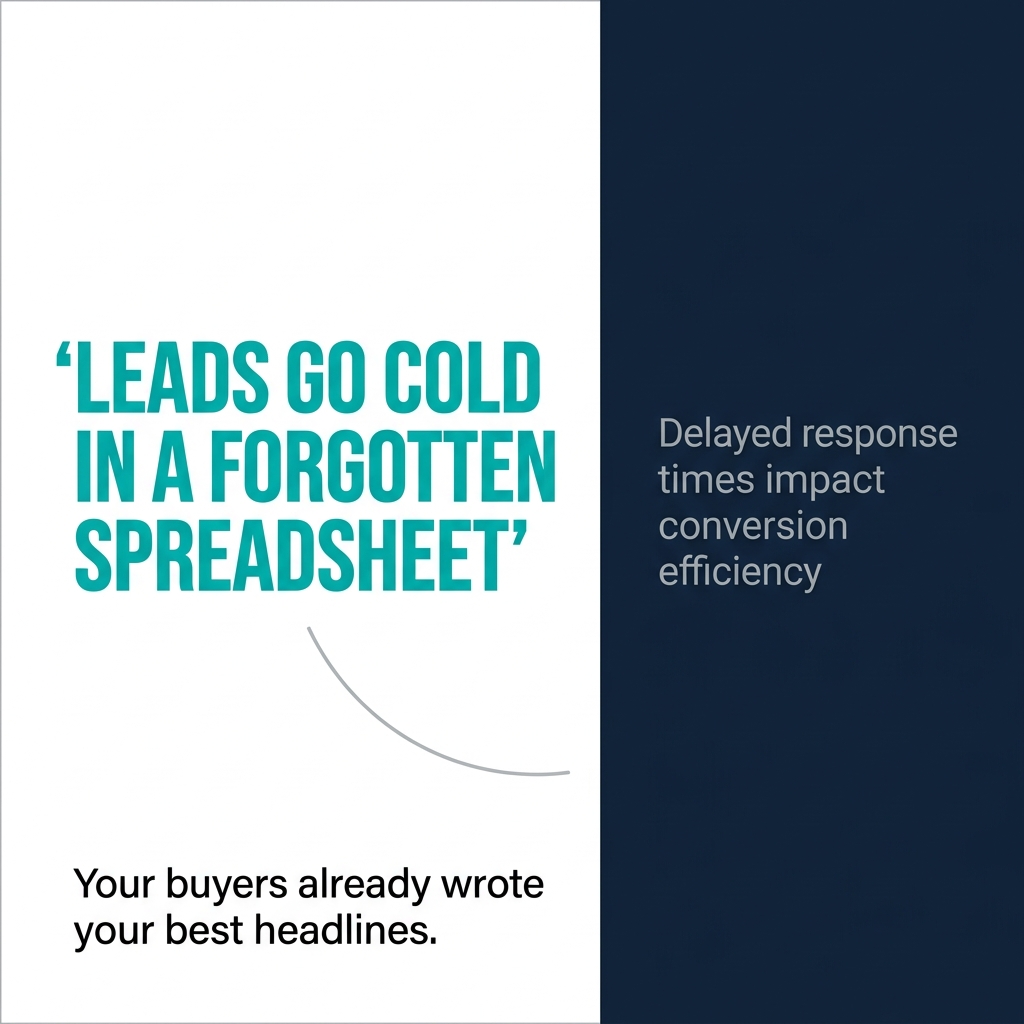
It was the language. Practitioners describing the same failure, over and over, in phrases no copywriter would draft. "Generating the lead is only half the job." "Time kills all deals." "Leads go cold in a forgotten spreadsheet."
After years of building marketing systems for service businesses, my view is straightforward. The most effective copy gets transcribed from buyers describing their own frustration. Your job is to listen, capture it, and use it almost word for word.
Why Does Buyer Language Outperform Polished Copy?
When a prospect reads "leads go cold in a forgotten spreadsheet," they recognise their own Tuesday morning. That recognition does more for trust than a clever headline.
Polished copy describes the problem from the outside. Buyer language describes it from the inside, emotion still attached. In the thread I studied, the phrase "the 20 minutes after" kept coming up as the critical conversion window. One commenter put it plainly: the capture side is solved territory, and the failure sits in the 20 minutes after someone raises their hand.
Five words. More urgency than a week of drafting would produce.
💡 Tip: The words carrying the highest emotional charge in any comment thread are usually the words worth borrowing.
The words with the most heat in any thread are worth far more than the ones you'd draft yourself.
Which Phrases Are Worth Stealing, and What Do They Reveal?
Across those 720 comments, a handful of phrases recurred so often they became market consensus:
"Broken follow-up process" was the most repeated diagnosis.
"Who owns the lead?" surfaced as the structural question behind most failures.
"Two roommates who never talk" described the marketing and sales handoff.
"Campaigns get blamed, channels get killed, when the follow-up leaked" named the misdiagnosis that 138 commenters described explicitly.
Each phrase does double duty. It works as copy, and it tells you where the real problem lives. The complaints cluster around speed, consistency, and ownership. That triad, articulated by buyers themselves, is the architecture of the solution they want to purchase.
Service businesses write about features and process. Their buyers are already writing the sales page for them, in comment sections, support tickets, and discovery calls. Most just don't look.
Bottom line: Your buyers have already written your best copy. The work is finding it.
How Do You Transcribe Buyer Frustration in Practice?
This is the method I use with clients at NEXUSPRO. It follows the 80/20 principle I apply to everything: a small amount of focused listening produces most of your best copy.
Find the watering holes. Comment threads, industry forums, competitor reviews. Places where buyers vent without a salesperson in the room.
Record calls and pull direct quotes. The exact words a prospect uses to describe their frustration in a discovery call belong in your next headline.
Sort by repetition. A phrase that appears once is an anecdote. A phrase that appears dozens of times, the way "only half the job" did, is your opening line.
Keep the wording intact. Resist the urge to clean it up. "Sits in a queue until someone opens the CRM the next morning" beats "delayed response times" every single time.
Match the copy to the diagnosis. If buyers blame their campaigns when the follow-up leaked, your copy should name that misdiagnosis directly. It reframes the conversation before you pitch anything.
⚠️ One caution: borrow the language honestly. Use it because it reflects a problem you genuinely solve, and never attach promises of specific financial results to it.
Key point: Listening with intent for 80 minutes will produce better copy than writing for 8 hours.
What Does This Mean for Your Marketing This Week?
Strategy before tools. This is a case in point. Before writing another landing page or setting up another email sequence, spend two hours reading what your buyers say when they think nobody is selling to them.
Your headlines will be sitting there, already written.
The businesses I work with spend fewer than five hours a week on marketing. Transcribing buyer language fits that reality. It removes the hardest part, which is deciding what to say, because your market has already said it.
Start with one thread, one review page, or one recorded call. Pull out five phrases your buyers use to describe their frustration. Put the strongest one at the top of your next piece of copy.
Then see how differently people respond when they read their own words back to them.
Quick win: One comment thread, one review page, or one recorded call is enough to start. Five phrases. One at the top of your next page.
Frequently Asked Questions
Why is buyer language more effective than professionally written copy?
Because buyers write from inside the frustration, not outside it. The emotional charge is intact. Professional copy describes the problem; buyer language makes the reader feel seen.
Where do I find buyer language for my service business?
Comment threads on industry LinkedIn posts, Google and Trustpilot reviews of competitors, recorded discovery calls, and support ticket logs are the richest sources.
How do I know which phrases are worth using?
Repetition. A phrase that surfaces once is an anecdote. A phrase that surfaces across dozens of comments or calls is a signal your buyers are using it to define their problem.
Should I use buyer phrases word for word or clean them up?
Use them as close to verbatim as possible. The roughness is the point. "Sits in a queue until someone opens the CRM the next morning" is more powerful than "delayed response times" precisely because it's specific and unpolished.
What is the 20-minute window in lead follow-up?
It refers to the critical period immediately after a lead is captured. Research and practitioner consensus both indicate that responding within five to twenty minutes significantly increases conversion rates, in some cases by 30 to 70%.
How does this apply to the 80/20 principle?
A small amount of focused listening, one thread, one call, one review page, produces most of your best copy. You don't need to research everything. You need to find the phrases that recur most often and use those first.
Is this approach ethical, and are there limits?
Yes, with one clear boundary: use buyer language only to describe problems you genuinely solve. Never attach specific financial promises or guaranteed outcomes to copy drawn from buyer frustration.
What if my buyers aren't active in comment threads or online forums?
Your discovery calls and support conversations are the alternative. Record them with consent, review the transcripts, and extract the phrases your prospects use to describe their situation before you've explained your solution.
Key Takeaways
The most effective copy for service businesses is already written by buyers describing their own frustration.
Phrases like "generating the lead is only half the job" and "the 20 minutes after" carry more conversion power than polished alternatives.
The primary failure in lead generation happens post-capture, in the follow-up, not at the top of the funnel.
Speed, consistency, and lead ownership are the three themes buyers name repeatedly. Build your copy and your solution around all three.
Repetition is the filter. A phrase that recurs across multiple sources is a signal, not an anecdote.
Keep buyer language raw. The specificity and roughness is what makes it land.
80/20 applies here: two hours of focused listening will outperform eight hours of writing.