 NexiAI
 CleoAI
 VoxAI
VoxAI OttoAI
 RingoAI
 CallumAI
 WinnieAI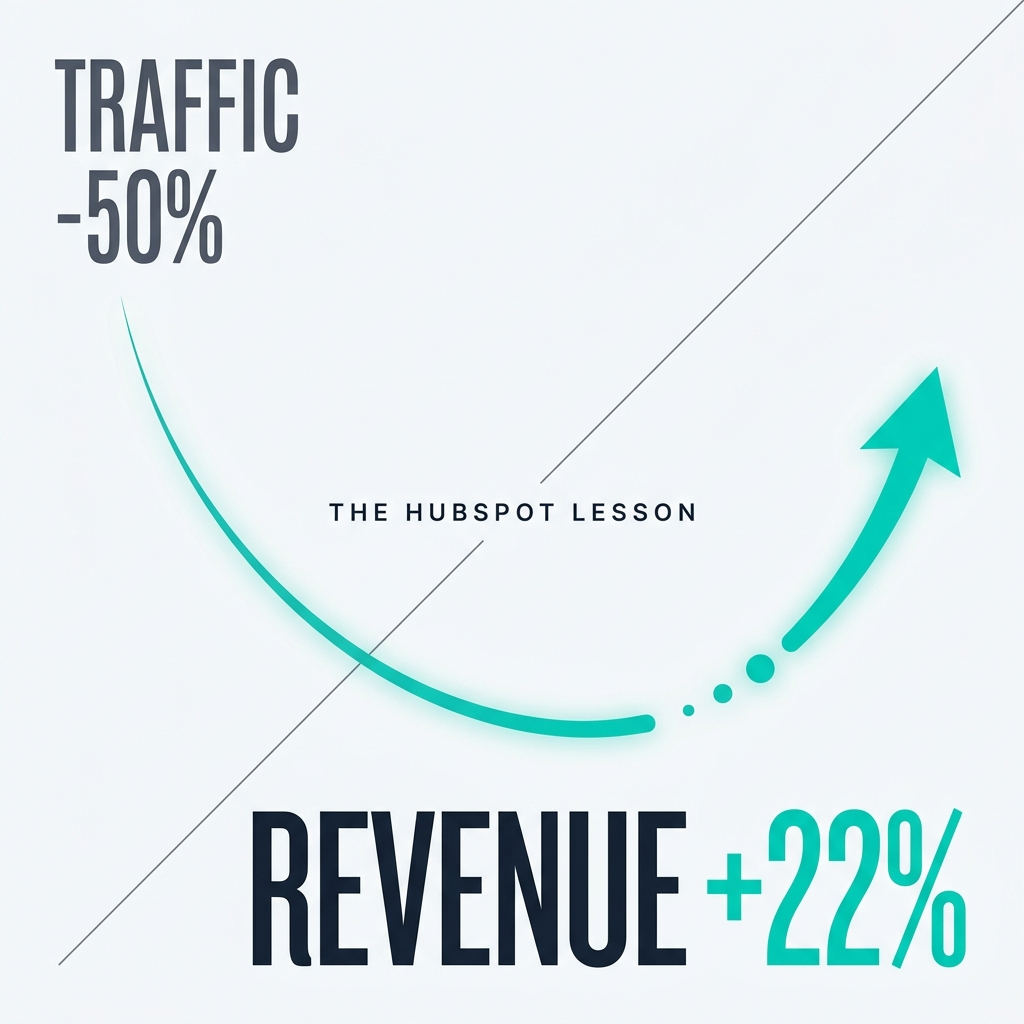
Why Publishers Are Dying But Your Plumber Isn't
TL;DR: AI search is causing real damage, but it is concentrating that damage on publishers and national content businesses. Local service businesses have structural advantages that most of the panic-driven commentary completely ignores. Here is what is actually happening and what to do this week.
68% of Google searches now end with zero clicks, and AI Overviews cut click-through rates by around 60%.
Local transactional queries like "emergency plumber near me" cannot be answered by an AI paragraph, so local service businesses are far less exposed than publishers.
HubSpot lost over half its organic traffic and grew revenue by 22% in the same period. Traffic volume was never the real metric.
Your Google Business Profile now drives 32% of Local Pack ranking weight. Ignore it and you hand that ground to a competitor.
Review language matters more than star ratings. Specific reviews with service details, prices, and location give AI something to cite on your behalf.
The Zero-Click Era Has Already Arrived
I keep hearing the same warning from marketers: AI has broken search, traffic is collapsing, and every business that depends on Google is in trouble.
Half of that is true.
The other half is lazy thinking, and it is causing local service business owners a lot of unnecessary panic. I have spent twenty years implementing marketing technology for small businesses. The AI search shift hits different businesses in completely different ways. Publishers and traffic-dependent national brands are getting hurt. Your local plumber, electrician, or accountant sits in a far stronger position than the headlines suggest.
Start with the numbers. By early 2026, 68% of Google searches ended without a single click to the open web, up from 60% two years earlier. When an AI Overview appears, and it now shows up in nearly half of all searches, click-through rates fall by around 60%.
This has been building for years. Knowledge panels, featured snippets, and map packs all trained Google to answer questions on the results page. AI scaled it.
Which questions get answered on the page matters enormously.
Informational queries like "how much does a boiler service cost" get summarised by AI. The searcher reads the answer and leaves. Local transactional queries behave differently. Someone standing in a flooded kitchen searching "emergency plumber near me" needs a human with a van and a wrench. An AI paragraph solves nothing for them.
Publishers built their entire business on the first type of query. Local service businesses live on the second. That single distinction explains most of what is happening.
Key Point: Zero-click search is real, but which type of query your business lives on determines whether AI Overviews are a threat or a non-issue.
What HubSpot's Traffic Collapse Actually Proves
The clearest evidence comes from HubSpot. Their organic traffic fell by more than half, from 13.5 million visits down to roughly 6 to 7 million. In the same period, revenue grew 22% year on year.
Traffic collapsed. Revenue grew by 22%.
The explanation is uncomfortable for the SEO industry. A huge share of that traffic never generated revenue in the first place. It was top-of-funnel blog content, read by students and casual browsers, while the actual product sold through sales teams and brand demand. People kept searching for HubSpot by name. They stopped clicking generic "best CRM" listicles.
The question that matters shifted from "how much traffic do we get" to "does this traffic convert".
I apply the 80/20 principle ruthlessly in my own work, and this is it playing out at scale. A small fraction of visits produced nearly all the value. AI stripped away the 80% that produced very little, and the business barely felt it.
💡 If you cannot draw a line from a traffic source to booked jobs or signed contracts, treat that traffic as decoration, and plan as if it will disappear.
Key Point: Traffic volume was always a vanity metric for businesses that sell through trust and reputation. AI is just making that more obvious, faster.
Why Generic Content Has Become a Liability
When fifty websites give the same answer to the same question, AI compresses them into one paragraph and cites almost nobody. Google now actively de-indexes content that repeats existing information without adding anything new.
The new standard is informationally additive content. Every piece needs to contribute something the top existing results do not already say.
For years, sameness was the safe SEO play. Copy the top result, pad it out, add a keyword. That approach is now a ranking penalty. This is genuinely good news for real practitioners. A plumber who has completed 400 jobs in one city holds pricing data, failure patterns, and local knowledge that no content farm can fake.
The businesses in trouble sit in the middle: enough content to compete on volume, no authority and no niche. The survivors sit at both ends. Large brands with genuine authority hold one end. Small specialists with a loyal local audience hold the other. A single-location tradesperson occupies that specialist end by default.
Key Point: The local service business with real job data and local specificity is now a better content asset than a national brand publishing generic guides.
Your Google Business Profile Is Now Mission Critical
Nearly every AI tool, including Gemini and ChatGPT through Bing, treats your Google Business Profile as the central record of your business. GBP signals account for 32% of Local Pack ranking weight, with reviews adding another 20%. Over half of your local visibility sits inside a free tool that many owners set up once and forget.
That concentration creates real risk. A competitor with local guide status can suggest edits to your profile, and Google sometimes accepts them. A changed business category can cut your call volume within days. Local SEO has its own version of building on rented land. The landlord is different, the lease terms are the same.
Treat the profile like infrastructure:
Audit it monthly. Check categories, hours, services, and photos for unauthorised changes.
Complete every field. Google's AI-powered Ask Maps feature, which replaced the old Q&A section in late 2025, synthesises answers about your business from your profile, your reviews, and your website. Gaps become wrong answers.
Connect it to your other systems. Your profile, your reviews, and your booking flow should work as one machine, and this is exactly the kind of consolidation I build for clients every week.
Key Point: Your Google Business Profile is no longer just a listing. It is the primary data source AI tools use to represent your business. Treat it accordingly.
Reviews Are Data Now, So Coach the Language
Star ratings mattered when humans scanned a list. AI reads the words.
When someone asks an AI assistant "how much does water heater replacement cost near me", the system mines review text for concrete answers. A review that says "great service, five stars" gives it nothing. A review that says "they replaced my water heater for £2,800 and finished in four hours" gives it a service, a price, an outcome, and a location to cite.
Ask happy customers to name the job, the area, and the result. One specific sentence in a review now does more work than ten vague ones. This is commonly overlooked, and it costs businesses citations they have already earned.
Key Point: A detailed review is free marketing data that AI will cite when answering cost and service questions in your area. Most businesses are leaving this entirely to chance.
Search Is Everywhere Now, So Aim for Recall
Search left the search box a while ago. ChatGPT now processes 2.5 billion prompts daily. People search on YouTube, TikTok, Reddit, Perplexity, and inside Maps itself. Proximity is also losing its grip on local rankings. As Ask Maps matches businesses on attributes rather than distance, being nearby decides eligibility, and your reputation decides the order. A well-documented business will win an entire city rather than a postcode.
Across large-scale studies, top-performing sites earn nearly four times more of their search traffic from their own brand name than average sites. People search for them directly. When HubSpot's clicks dropped, searches for "HubSpot" carried on. So did revenue.
That is the goal: become the name people type, on every platform they use.
Key Point: The shift from ranking to being remembered is the central challenge. Brand recall, across every platform, is what protects revenue when click volumes fall.
Your Move This Week
Simplify before you add anything. Complexity breeds chaos and inefficiency, and this moment rewards focus more than ever.
Map your revenue sources. Identify the 20% of channels producing real jobs. Protect those first.
Audit your Google Business Profile today. Fill every field, then diarise a monthly check.
Rewrite your review request. Ask customers to mention the service, the price range, and the outcome.
Publish what only you know. Real job costs, real timelines, real local detail. Delete or rewrite anything generic.
Track brand searches. Watch how many people look for your business by name. That number tells you whether you are being remembered.
Publishers built on borrowed attention, and AI is calling in the loan. You built on completed jobs, local reputation, and customers who know your name. Consolidate your tools, tighten your profile, and coach your reviews. This shift works in your favour.
The businesses that get this right will spend less time chasing traffic and more time answering the phone.
Frequently Asked Questions
Does AI search hurt local service businesses the same way it hurts publishers?
No. Publishers depend on informational queries, which AI now answers on the search page. Local service businesses depend on transactional queries where someone needs a person to show up. AI cannot replace that, so the exposure is fundamentally different.
Should I stop investing in SEO for my local business?
Invest differently, not less. Generic content has become less effective. Content built on real local data, specific job costs, real timelines, and local specifics, is now more valuable than it has ever been.
How important is my Google Business Profile really?
GBP signals account for 32% of Local Pack ranking weight, with reviews adding another 20%. That means over half your local visibility depends on a free profile that AI tools treat as your primary business record. It is the highest-return item on your to-do list.
What makes a good review in an AI search environment?
Specificity. A review that names the service performed, the rough price paid, the location, and the outcome gives AI concrete data to cite. Vague five-star reviews contribute almost nothing to how AI represents your business.
How do I know if AI tools are recommending my business?
Search for your own services on ChatGPT, Gemini, and Perplexity as if you were a new customer. Ask for recommendations in your city. If your business does not appear, your profile, reviews, or content are not giving these systems enough to work with.
What is the "barbell" survival strategy in local search?
The businesses most at risk from AI search sit in the middle: large enough to produce a lot of content, but without genuine authority or a tight local niche. Survivors are either large authoritative brands or small niche specialists. Local service businesses naturally occupy the niche end of that barbell.
How does Ask Maps change local rankings?
Google's Ask Maps, which launched in late 2025, integrates Gemini into Google Maps and recommends businesses based on service-specific attributes rather than proximity alone. Proximity still determines eligibility, but the ranking order is increasingly driven by how well your profile, reviews, and content match what the user is asking for.
How do I build brand recall across multiple platforms?
Consistency and specificity. Show up on the platforms your customers actually use with content that only you could produce. Real job stories, local pricing context, and specific outcomes build the kind of brand memory that makes someone type your name rather than a generic search term.
Key Takeaways
68% of Google searches end without a click. The damage is real, but it is concentrated in informational content, not local service queries.
HubSpot's traffic fell by over 50% while revenue grew 22%. Traffic volume is the wrong metric. Conversion is what counts.
Generic content is now a ranking liability. Unique local data, real job costs, and specific local knowledge are your competitive advantage.
Your Google Business Profile drives over half your local visibility. Audit it monthly. Fill every field. Connect it to your booking systems.
Review language is now a data source for AI. Coach customers to name the service, the price, and the area. One specific review outperforms ten vague ones.
Search now happens on ChatGPT, YouTube, TikTok, Reddit, and Perplexity. The goal shifts from ranking to being the name people already know to search for.
Local service businesses have a structural advantage in this shift. The businesses that consolidate their tools, strengthen their profiles, and coach their reviews will take market share from those that don't.

