

Your Leads Are Fine. Your Follow-Up Is the Leak.
TL;DR: Most service businesses lose revenue not from bad campaigns, but from slow, inconsistent follow-up after a lead arrives. Fix the follow-up before you touch the budget.
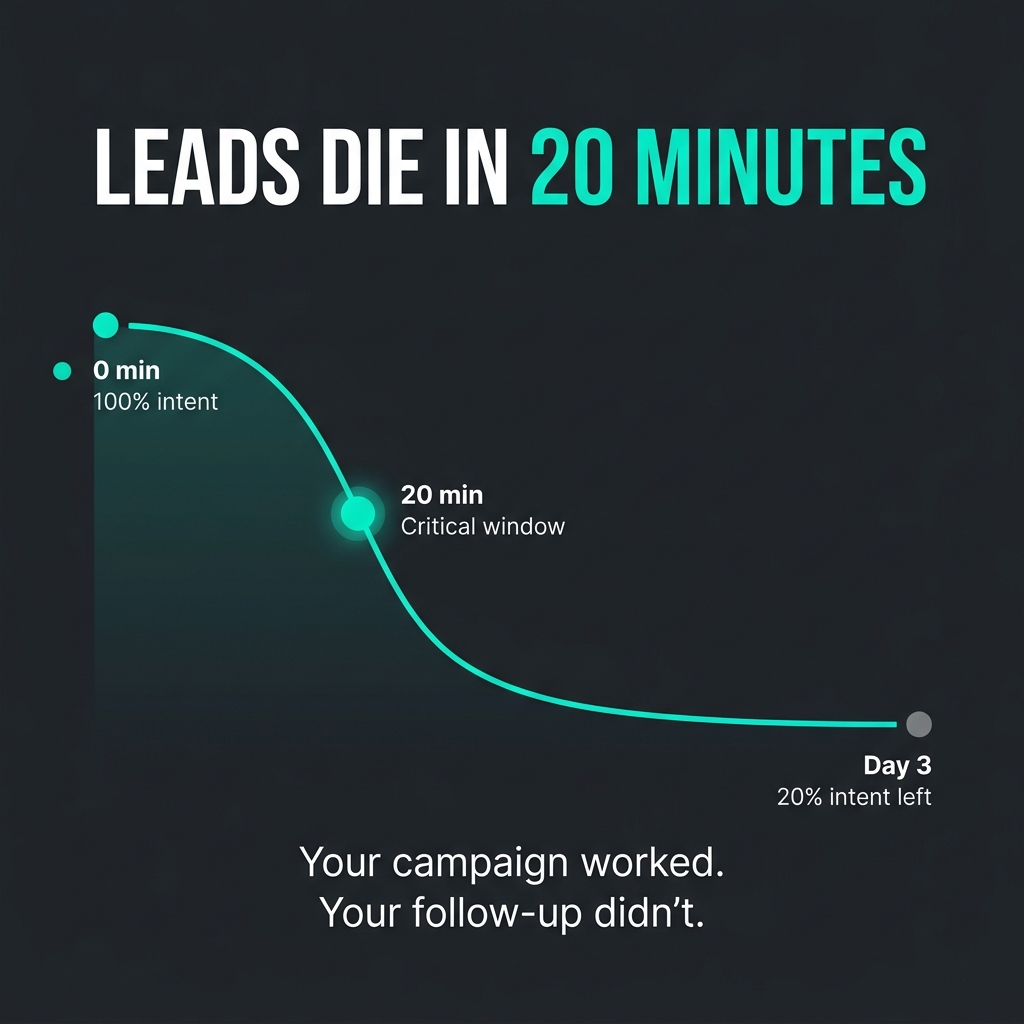
Buyer intent drops fast after someone fills in a form — the first 20 minutes matter more than the next 20 hours.
The bottleneck is usually the owner, not the campaign.
A basic CRM sequence on day one, day three, and day five stops most of the bleed.
Speed, consistency, and named ownership of every lead are the three things that actually move conversion rates.
Fixing the follow-up costs far less than buying more leads and sending them into the same broken process.
What Actually Goes Wrong After a Lead Arrives
A campaign generates leads. Conversions disappoint. The campaign gets blamed. The budget gets cut.
Then you open the CRM and find the real story. Leads sitting there for two, three days. Nobody called. Nobody emailed. Nobody was assigned to own them.
Generating the lead is only half the job. The other half happens in the minutes and days after someone raises their hand. That's where revenue quietly bleeds out.
Buyer intent moves fast. Someone who fills in a form is mentally present in that moment — they've named their problem and taken a step. By the next morning, their priorities have shifted and inertia has taken over. A lead sitting in a queue until someone opens the CRM tomorrow is a lead going cold on your watch.
This matters because it changes where you spend. Fixing the follow-up costs far less than buying more leads to send into the same leaky process.
Bottom line: Before you adjust the campaign, check what happened after the last lead landed.
Why Campaigns Take the Blame They Don't Deserve
Business owners tend to point at the top of the funnel when conversion rates disappoint. The targeting, the channel, the ad spend. That instinct makes sense because the campaign is visible and measurable.
The actual failure sits after the lead is captured. That part is harder to see, especially when the founder is the one dropping the ball, not deliberately, just because they're in the field, solving problems, doing the actual work.
There's a real blind spot here. Owners often believe that sending one quote and one text message counts as follow-up. Meanwhile, a competitor sent five touchpoints in the same window. The lead didn't go cold because they lost interest. Someone else got there first.
Bottom line: Blaming the campaign before auditing the follow-up is the most expensive assumption in small business marketing.
How the Follow-Up Breaks Down and Who Owns It
The fix is a process, a system, or a person, depending on how your business is built. Sometimes all three.
A skilled salesperson on commission develops their own follow-up rhythm instinctively. They chase every enquiry because their income depends on it. If you have someone like that, your leak is already smaller than most service businesses.
Realistically, the person handling enquiries at a $3M to $5M service business is the owner, an admin coordinator, or a technician between jobs. Follow-up competes with everything else on their plate. And it loses.
That's when you need structure:
Tighter process. A written follow-up routine with a named owner, so every lead has someone accountable from form-fill to first conversation.
Automation that does the chasing. A system that responds instantly and keeps following up, even when your team is on site.
I've worked with business owners who hired an admin assistant specifically to follow up leads, and the shift was immediate. Every lead got touched. The owner stopped being the bottleneck. That visibility, knowing every enquiry was getting a response, opened them up to fixing the rest of the sales process too.
Bottom line: The skill level of the person handling leads determines how much process you need around them. Build accordingly.
What Speed to Lead Actually Does to Conversion Rates
The 20-minute window after a lead arrives is where the most is won or lost. Studies point to conversion rate lifts of 30 to 70 percent from responding within the first five to fifteen minutes, compared to waiting until the next day.
That improvement doesn't come from a better campaign, better targeting, or a bigger ad budget. It comes from being first.
An automated response within minutes, even a simple one, holds the buyer's attention while their intent is still warm. It buys time for a human to follow up properly. That's really what it's doing: bridging the moment of capture and the first real conversation.
Bottom line: Speed to lead is a behavioural reality. Engage when interest is at its peak, because that window closes fast.
The Three Things That Make Follow-Up Actually Work
Every effective follow-up setup comes down to three elements working together.
Speed. An instant reply, even automated, holds the buyer while intent is warm. The first 20 minutes after capture are the highest-value window you have.
Consistency. One follow-up attempt is not a process. A cadence across day one, day three, and day five catches people at different moments and signals that you are serious about earning their business.
Ownership. Between the form-fill and the first human contact, a named person must own that lead. Marketing and sales often operate in silos with no clear handover. Leads fall through because nobody thought it was their job to follow up. Ambiguity is where deals die in forgotten spreadsheets.
A tool alone fixes none of this. A person alone struggles to sustain it. The businesses that convert well combine all three, and the combination matters more than any single piece.
Bottom line: Speed + Consistency + Ownership. If any one of the three is missing, the other two won't save the conversion.
How to Start Qualifying Leads Before Anyone Picks Up the Phone
Here's something most businesses haven't thought through. Lead qualification can start before a human ever gets involved.
A basic contact form that collects a name and an email address treats every enquiry identically. But a form that asks about budget, urgency, or project goals starts the sales conversation from minute one. By the time someone follows up, they already know whether they're dealing with a serious buyer or someone kicking tyres.
Less than 10% of the service businesses I work with have this in place when they come to me. And it's one of the highest-leverage changes you can make, because it shapes the entire follow-up that comes after.
Your website copy, your social content, and the way you show your process all do a version of this too. The right prospects recognise themselves in what you publish. The wrong ones filter themselves out before they ever fill in a form. Lead qualification starts in the marketing, well before the enquiry lands.
Bottom line: Build qualification into the capture process itself, and your follow-up becomes faster, smarter, and far less wasted effort.
The Simplest Version That Works
The 80/20 principle applies directly here. A small amount of follow-up infrastructure delivers the bulk of the result.
Start with this:
Put every lead into one CRM, no exceptions.
Send an automated response within minutes of capture.
Build a day one, day three, day five sequence.
Assign a named person to every lead the moment it lands.
Review unanswered leads once a week and ask why they stalled.
Once that runs reliably, you can go further. Feed your closed-won and closed-lost data back into your targeting, so each campaign produces better leads than the last. Few businesses do this. Get the foundation working first.
Bottom line: You don't need a sophisticated tech stack to stop leads going cold. You need a consistent, simple system that runs every time.
Fix the Leak Before You Buy More Water
Before spending another pound on lead generation, audit what happens in the 20 minutes after a lead arrives. Check who owns it, how fast the first response goes out, and what happens on day three when nobody has replied.
Your marketing probably worked. Your leads were real. The leak sat in what happened next, and that's fixable this week with a process, a system, or the right person in place.
Frequently Asked Questions
How quickly should a business follow up on a new lead?
Within five to fifteen minutes where possible. Studies suggest responding in this window can lift conversion rates by 30 to 70 percent compared to following up the next day. Even an automated acknowledgement buys time for a human to follow up properly.
What is speed to lead and why does it matter?
Speed to lead refers to how fast a business responds after a prospect submits an enquiry. Buyer intent is highest at the moment of form-fill and drops sharply within hours. The faster the first response, the more likely the lead converts before interest fades or a competitor responds first.
What is the minimum follow-up system a small service business needs?
A basic CRM with an automated response sent immediately, followed by a follow-up sequence on day one, day three, and day five. Every lead needs a named person assigned to own it from enquiry to first conversation.
Why does the founder often become the bottleneck in lead follow-up?
Founders are usually the most motivated to close new business, but also the most pulled in different directions: managing delivery, solving problems on site, handling operations. Follow-up competes with everything and often loses. Removing the founder from the follow-up chain, through automation or a dedicated person, is one of the highest-leverage moves a growing service business can make.
What is a follow-up cadence and how should it be structured?
A follow-up cadence is a planned sequence of contact attempts after a lead arrives. A simple and effective version is day one, day three, and day five. This catches prospects at different moments, signals persistence without being intrusive, and ensures no lead goes dark by default.
How does lead qualification improve follow-up?
When a form asks about budget, urgency, or goals at the point of capture, the follow-up can be tailored to that specific situation rather than treating every lead identically. This saves time, improves conversion, and helps the business prioritise its highest-value enquiries first.