 NexiAI
 CleoAI
 VoxAI
VoxAI OttoAI
 RingoAI
 CallumAI
 WinnieAI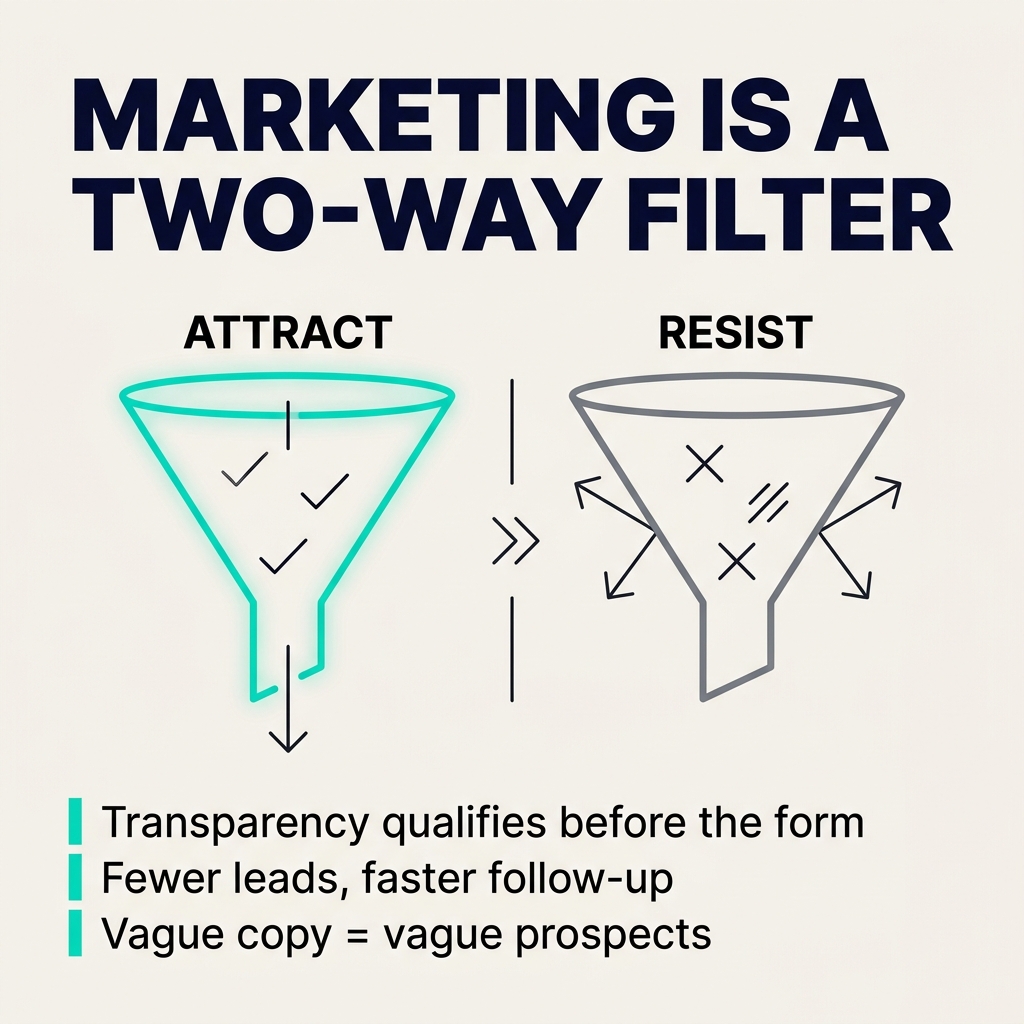
Your Marketing Should Push Some People Away. That Is the Point.
TL;DR: Marketing that tries to attract everyone ends up converting no one. Building a deliberate filter into your copy, one that repels the wrong prospect before they ever fill in a form, protects your response speed, improves your conversion rate, and makes your follow-up actually work.
Lead qualification starts at the headline, not the contact form.
Your copy is either filtering prospects in and out on purpose, or doing it by accident.
Unqualified leads clog the follow-up queue and slow down your response to the right prospects.
Transparency about who you serve, and who you do not, builds trust with the people who are actually a fit.
Fewer, better leads mean faster follow-up and stronger conversion rates.
I spend a lot of time inside the marketing systems of service businesses. When I audit them, I keep running into the same assumption baked into every page, every ad and every email: the job of marketing is to attract as many people as possible.
I want to challenge that.
Marketing is both an attraction process and a resisting process. You are trying to pull the right prospect towards you, and at the same time you are keeping the wrong prospect away. Your sales copy, your website, your social media all do this work, whether you designed them to or not.
Why Does Qualification Start Before the Form?
Service business owners tend to think lead qualification begins when someone fills out a form or picks up the phone. In my experience, that is far too late.
The qualification process starts the moment a prospect reads your headline. It continues through every page they visit. By the time they contact you, they have already qualified or disqualified themselves, based entirely on what your copy said, or failed to say.
Your content is your first filter.
When you show the kind of work you do, how you do it, and what your process looks like, two things happen at once. The right person leans in. The wrong person quietly moves on.
Both of those are wins.
Key Point: Qualification is not a sales step. It is a content design decision that starts at your headline and runs through every page a prospect touches before they ever contact you.
How Does Transparency Work as a Filter?
The way you build this filter is through being specific and honest about what you do, for whom, and how.
Who you serve. Name the type of business, the size, the situation.
How you work. Show the process, the timeline, the level of involvement you expect.
What you believe. State your approach plainly, even where some readers will disagree.
Who you are wrong for. Say it openly. It builds trust with everyone else.
At NEXUSPRO we tell people we work with service businesses in a specific revenue range, and we tell them we are a poor fit for large enterprises and one-person operations. That single act of honesty saves both sides hours of wasted conversation.
Specific copy attracts specific prospects and repels the rest. This feels risky when you first do it because narrowing the funnel goes against the instinct to cast wide. In practice, it strengthens the funnel considerably.
Key Point: Vague messaging fills your pipeline with vague prospects. Saying clearly who you are wrong for is one of the highest-leverage moves you can make on a services page.
Why Does This Matter for Lead Follow-Up?
There is broad agreement across the marketing world that the biggest leak in lead generation happens after capture, not before it. As one widely repeated line puts it:
Generating the lead is only half the job.
Leads come in, then they sit in a spreadsheet or a CRM queue until someone opens it the next morning. Buyer intent drops fast. The critical window is the short period straight after someone raises their hand, and most teams miss it.
Think about what a pipeline full of unqualified leads actually does to that window.
Your team spends its fastest, most valuable response time on people who were never a fit. The right prospects wait longer because the wrong ones clog the queue. Then the campaign gets blamed for poor conversion, when the real issues sit in the filtering and the follow-up.
Resisting the wrong prospect at the top of the funnel protects your speed at the bottom of it. Fewer, better leads mean you respond faster to the people who matter.
Key Point: Unqualified leads are not a neutral problem. They actively drain the response capacity you need for the prospects who are genuinely ready to buy.
How Do You Build the Filter Into Your Copy?
Three practical steps I use with clients:
Write your \'not for\' statement. One sentence on your services page that names who should walk past. It sharpens everything around it.
Show your process publicly. Prospects who dislike your process will opt out before they cost you time. Prospects who like it arrive half sold.
Publish your point of view. I believe you have to simplify things to make them grow. Complexity breeds chaos and inefficiency. Stating that view attracts owners who think the same way and filters out those who want more tools rather than more clarity.
Then connect the filter to fast follow-up. Route every qualified enquiry to a named owner with a clear next step. Speed, consistency and ownership complete the system that your copy started.
Key Point: Three moves, done well, change who walks through the door: name who you are wrong for, show your process, and state your point of view plainly. The copy does the sorting so your team does not have to.
What Does Good Look Like?
You already run a qualification process. It runs on every page you publish, whether you shaped it or left it to chance.
Shape it deliberately. Use your copy to attract the right person and to keep the wrong one away. Your follow-up gets faster, your conversations get better, and your marketing finally gets credit for the work it does.
Start with one page this week. Read it and ask whether a poor-fit prospect would rule themselves out. If the answer is no, the page needs more honesty, and probably fewer words.
Key Point: Deliberate copy design is not a branding exercise. It is a conversion decision that saves time, sharpens follow-up, and gets better outcomes from the leads you already generate.
Frequently Asked Questions
Does narrowing my target audience mean I will get fewer leads?
Yes, in volume. But the leads you do get will be far closer to qualified. Fewer unqualified enquiries means your team has more capacity to respond quickly to the ones that matter, and speed of response is one of the biggest drivers of conversion in service businesses.
What is a not-for statement and where do I put it?
A short, direct sentence that tells visitors who your offer is not suited for. Place it on your services page, ideally near the top or just above your call to action. For example: this service is built for service businesses with an established team and a marketing budget to invest. If you are looking for a quick, low-cost fix, this is probably not the right fit.
How specific does my process description need to be?
Specific enough that a prospect who dislikes working that way will recognise it and opt out. If your process involves a structured onboarding, a minimum commitment, or a particular working style, say so. Clarity here prevents mismatched expectations later.
How does lead qualification at the top of the funnel affect follow-up speed?
Directly. When your pipeline contains fewer unqualified leads, your team spends less time filtering and more time acting. The businesses that respond to the right leads within minutes consistently outperform those chasing volume with slow follow-up.
Can my contact form help qualify leads?
Yes. Adding two or three targeted questions, such as budget range, urgency, or specific goals, starts the qualification process before a human ever picks up the phone. By the time your team sees the enquiry, they already know whether it is worth prioritising.
What if I am worried about being too narrow and missing good leads?
Being specific in your copy does not stop a wide range of people from reading it. It does stop the wrong ones from wasting your team's time. The businesses that tend to underperform on conversion are usually the ones with the broadest, vaguest positioning.
How does publishing a point of view help with filtering?
A stated belief attracts people who agree and signals to those who do not that this may not be the right fit. Stating that simplicity beats complexity, for example, will resonate strongly with founders who are frustrated by overcomplicated tools, and it will quietly discourage buyers who are simply shopping for more features.
Key Takeaways
Marketing is both an attraction and a filtering process. Your copy does this work with or without your input.
Lead qualification starts at your headline, not at your contact form. By the time someone submits an enquiry, they have already self-selected based on what your content said.
Transparency about who you serve and who you do not builds credibility with the right prospects and saves time for your whole team.
Unqualified leads drain follow-up capacity. Protecting that capacity is one of the most direct ways to improve conversion without spending more on advertising.
Three practical moves make the biggest difference: write a clear not-for statement, show your process publicly, and state your point of view on how good marketing works.
Speed of follow-up is a competitive advantage. Fewer, better leads give you the capacity to act on that advantage.
Start small: pick one page this week, read it as a poor-fit prospect would, and ask whether they would rule themselves out. If the answer is no, the page needs more honesty.

